


The Pope’s pivot: toward fearing Islam less


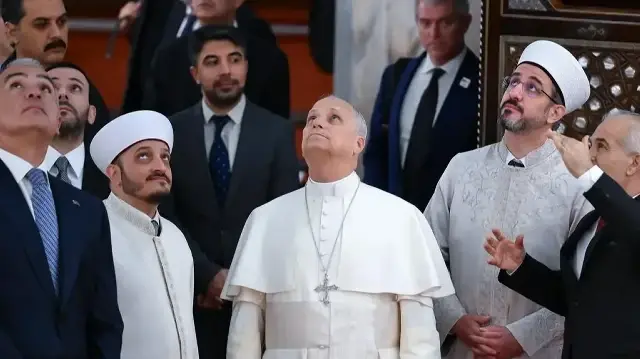
Pope Leo XIV traveled from Türkiye to Lebanon and, on his flight back to Rome from Beirut the day before yesterday, answered questions from reporters. La Croix, a French newspaper that also reflects the views of the Catholic Church, published the interview under the headline, “We should fear Islam less.” As soon as I read the Pope’s return-flight interview—and with the criticisms of my previous column still fresh in my mind—a respected elder encouraged me to read a newly published book directly related to this debate… In the interview, the Pope speaks not only as the spiritual leader of Christians but also makes a bold statement that European leaders have long been unwilling to make. He openly acknowledges both a fear and the need to overcome it. After discussing the interview with Fatih Karakaya, who leads Yeni Şafak’s French edition, he also emphasized that the headline should indeed be read as “We should fear Islam less.” So clearly, there is a major “fear” at play. The Pope’s exact words are as follows: “We should fear Islam less, whether in Europe or elsewhere. These fears are generally produced by those who are anti-immigrant and who seek to exclude people from other countries and other religions.”
POLITICAL PATH: A CRITIQUE OF HARDLINE CATHOLICISM
The Pope did not say these words out of nowhere; he said them in response to the question: “What do you think about the rise of identitarian rhetoric in the Catholic world and the portrayal of Islam as a threat?” With his emphasis on “less,” the Pope still sees Islam as a threat, but he is also criticizing the ‘hardline Catholic’ stance that focuses on keeping Muslims outside Europe. No one understands better than the Pope how hollowed out, weakened, and politically diminished the Catholic world has become. That is why his search, reflected in his statements, contacts, and self-criticisms, is not only religious but strategic. There is an unmistakable intention to find a “way out.” His words cannot be interpreted as “extending an olive branch to Muslims.” But this much is clear: The Pope is searching for political ways to “restore the Vatican as a global game-setter” in the face of Christianity’s global loss of power and the rise of the Zionist–Evangelical bloc.
A FORCED “ALLIANCE OF VALUES”
So why did the Pope begin by turning toward Türkiye? Because the Vatican now realizes something crucial: Achieving only a “Christian unity” is no longer enough to stop the spiritual collapse or to remain politically relevant on the global stage. In the face of Zionist expansionism and the globalist threat, forming a strategic “alliance of values” with the Islamic world is not a preference but a necessity for the Vatican. While taking this strategic step, the Pope delivered his most striking message to his own flock—to the Christian world itself. He openly challenged Europe’s inward-looking, diversity-fearing, threat-driven radical right. These words spoken on his return flight mark a turning point in Europe’s fierce identity debates today. It seems the Pope wants to bypass Europe’s walls—walls that shut out “the other”—by building bridges with Türkiye and the Islamic world. But here is the real irony: For those who know Europe’s last thousand years, the Pope’s call is not surprising. But for Europe itself, it is shocking. Because modern Europe’s fear of Islam is not a recent reaction produced by the far right. It is rooted in the founding codes of European identity.
THE “DESTRUCTIVE” CODES OF MODERN EUROPE
At this point, we must turn to Şener Aktürk’s book The Origins of the Modern World, published by Paradigma. Having read the book in a single night, I can summarize Aktürk’s central thesis in one sentence: “The modern world was built on the elimination of Muslims and Jews from Western Europe.” This sentence is not merely a historical observation—it illuminates the foundation of modern European identity. In other words, the entire narrative portraying Europe as “secular,” “pluralistic,” “progressive,” and “humanistic” is, in truth, a story built on a massive project of eradication, expulsions, and the belief that non-Christians were not fully human. A brief summary from the book: Throughout the Middle Ages, the Papacy was not merely a spiritual authority; it was Europe’s center of population engineering. After the Gregorian Reforms, the clergy adopted this horrifying doctrine: “Those who do not convert to Christianity lack the capacity for reason and are therefore not human.” Based on unprecedented research, Şener Aktürk observes that by 1526, not a single Muslim community remained in Western Europe—and that modern Europe was founded not on pluralism but on elimination.
“THE DEVIL’S WAR AGAINST MAN”
This is why the European Union’s refusal to accept Türkiye, its tendency to turn immigration debates into identity crises, and its constant portrayal of Muslim populations as a “demographic threat” are no coincidence. These reflexes are the secularized form of Europe’s historical codes. This is why calling the EU a “Christian Club” is not a political slogan—it is a conclusion validated by European history. From this perspective, the Pope’s call—“Let’s fear Islam less”—can be seen as an act of confrontation. But if Europe seriously debated these words, that alone would be a major event. Because the Pope is reminding Europe of something it has never possessed: “genuine pluralism.” Can the Pope’s half-hearted self-critique reshape Europe’s genetic codes? Hard to say. But the Pope clearly sees the coming “great flood.” He knows very well that globalist encroachments, gender-erasure projects, and the Zionist mindset target not only Muslims, but also Christianity, the family, and the natural order. If Pope Leo XIV succeeds in building a solid bridge with the Islamic world, it would benefit not only the Vatican but humanity as a whole. As for us, the position is clear: While recognizing Europe’s genetic hypocrisy, we must shake any hand extended to defend humanity’s shared values—with strategic clarity. Because the opposing front has already moved beyond the old Crescent and Cross conflict. Gaza has revealed this truth: “The Devil’s war against man” is turning the entire world into a bloodbath.
Comments you share on our site are a valuable resource for other users. Please be respectful of different opinions and other users. Avoid using rude, aggressive, derogatory, or discriminatory language.