


Syria’s security is Türkiye’s security

18:56, 30/11/2025, Sunday • Yeni Şafak English News Center

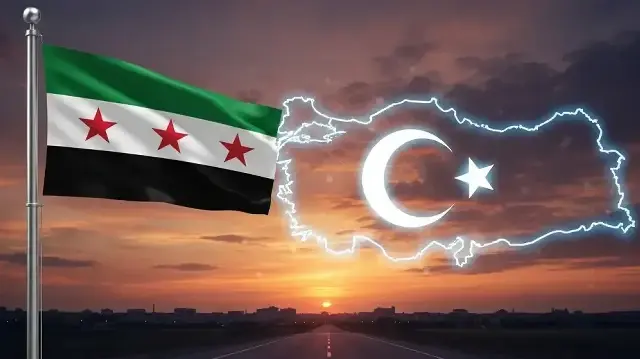
Syria’s security is Türkiye’s security
Syria’s civil war brought Türkiye and the United States into direct confrontation, revealing one of the biggest strategic rifts of the post–Cold War era. This rupture fundamentally reshaped regional geopolitics and ultimately produced outcomes in Türkiye’s favor.In the early years of the civil war, a coalition called the “Friends of Syria,” made up of 60 countries, was formed, and Türkiye became one of its most influential actors. At the time, it appeared as though the U.S. and Türkiye were pursuing the same goals, but it soon became clear how different those goals actually were.
Not long after, U.S. policy in Syria seemed to fall under the influence of Iranian thinking. After the killing of the U.S. ambassador in Libya, Washington abandoned its regime-change objective and shifted toward a strategy that allowed former Syrian President Bashar al-Assad to continue “wounded but intact.”
The U.S. shift toward focusing on Daesh and the PKK created an irreversible break with Türkiye. The cost of this divergence was severe:
- The U.S. and Iran persuaded the PKK to end the solution process in Türkiye.
- The Assad regime and Iran handed much of the Syria–Türkiye border to the PKK.
- Daesh appeared almost overnight and occupied one-third of the country.
- The U.S. then transferred territory taken from Daesh to the PKK.
- The PKK, Daesh, and FETÖ simultaneously launched attacks on Türkiye.
- FETÖ escalated this wave by attempting a coup.
As these developments unfolded on the Syrian front, Türkiye saw decades of relations built through the U.S. collapse. It was a burden no country could easily endure. Yet Türkiye, an ancient state with imperial experience, managed to withstand and overcome this breakdown.
Amid this intense threat environment, President Recep Tayyip Erdoğan decided to deploy hard power. The Euphrates Shield, Olive Branch, and Peace Spring operations were carried out successfully, showcasing to the world what the Turkish military can achieve even under the toughest conditions.
Türkiye’s naval deployment in the Mediterranean, its success in Libya, the neutralization of the PKK–Daesh–FETÖ triangle at home, and Azerbaijan’s victory in Karabakh all helped rebuild Türkiye’s regional relationships on a stronger geopolitical foundation.
This time, none of these diplomatic engagements were shaped through the U.S. or any other external power; they were rebuilt directly through Türkiye’s growing capacity.
Indeed, country after country began reaching out to Ankara. In an assessment I wrote for Yeni Şafak, I noted that “President Erdoğan worked like the UN Secretary-General over the past two months,” because the scale of diplomatic activity carried significant historical weight.
During the opening speech of a workshop held in Erbil, I described Türkiye’s regional role as follows: “Türkiye is a state with an imperial legacy. It has centuries of experience governing the world’s religions and nations. It is a country whose economy stands on trade. For this reason, regional stability directly serves Türkiye’s interests.”
The region’s second major country, Iran, adopted a completely different approach. With an oil-dependent economy and strong ideological drive, Iran has long relied on a “chaos theory” strategy, believing that instability in neighboring states is necessary for its own security. This is why Iran has opposed the stabilization of Iraq, Syria, and Lebanon.
This issue came up in later sessions of the conference. A Turkish academic seemed to misunderstand my reference to imperial experience and said, “Mr. Ihsan mentioned the empire; I want to emphasize ‘Peace at Home, Peace in the World.’” I still don’t know what that remark was intended to achieve.
When Iran and Russia gained dominance in Syria, they acted like occupying powers toward the Syrian people, which quickly fueled the Syrian popular revolution. Removing Iran and Russia from Syria did not prove difficult for Syrians.
After the Syrian Popular Revolution, a new idea of a unitary state has begun to take root in the region. Israel, meanwhile, is determined to maintain its occupation pressure to block this state-building process.
The SDG continues to produce excuses to avoid complying with the March 10 Agreement. Türkiye has made it absolutely clear that it will never allow a terrorist structure in northern Syria to evolve into a state. President Erdoğan’s message was, as always, unequivocal: “We do not want a terror-state in the region.”
At the same time, all parties continue to show a willingness to resolve the issue through diplomacy. The meeting with Abdullah Öcalan should also be seen in this context. For Türkiye, one fundamental truth remains unchanged: Syria’s security is Türkiye’s security.