


Jamaat-e-Islami in Pakistan is at a turning point...

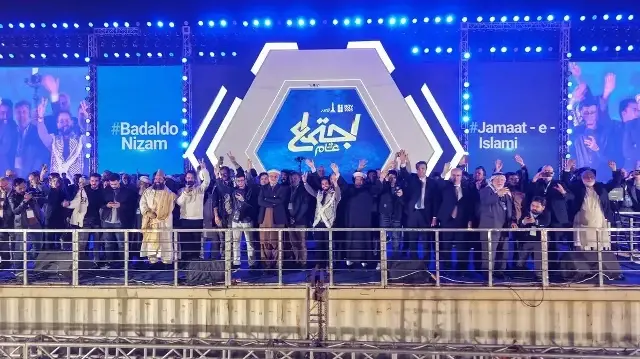
LAHORE. About a month and a half ago, when I received an invitation to attend the annual congress of Pakistan’s Jamaat-e-Islami (JI) and the international conference that would follow, I was excited and immediately confirmed I would be there. To be honest, this time it was a different kind of event compared to their usual congresses. As far as I remember, it was the first time international participation was given so much importance, with special sessions planned specifically for it.
When the day came, we set off for Lahore. Posters featuring JI and its new leader, Naeem ur Rahman, were displayed all over Lahore’s streets and on the backs of cars. The congress was unfolding as the most significant event in this city of 18 million. As I expected, the congress drew major interest from Muslim scholars, politicians, and intellectuals from across the Islamic world. I ran into many people I had known for years—more than I expected—and over the four days we came together for conversations in various settings.
Founded by Abul Ala Maududi, JI has had an undeniably important role in shaping Pakistan’s religious identity and cultural formation, and it is a movement I have tried to follow for as long as I can remember. It remains one of the most significant, organized, deep-rooted, and institutional movements in the Islamic world. I have mentioned this many times before: after the abolition of the Caliphate in Türkiye in 1924, leaving Muslims worldwide without a central authority, the Muslim world tried not to remain helpless by establishing two major international civil society structures in a short period. One was the Muslim Brotherhood, founded in Egypt in 1928 and quickly organized across the Middle East. The other was Jamaat-e-Islami, founded by Maududi in India in 1941.
Advertisement
In fact, both movements stand as an example of dignity in the face of the “a few bandit Arabs stabbed us in the back” narrative—spitting in the face of those who fabricated that story. Their emergence is concrete proof of a powerful social base that persisted with resolve and perseverance in upholding the mission the Ottomans had carried for six centuries.
Everyone now knows how the Indian Khilafat Movement—the base that later formed JI—contributed passionately, wholeheartedly, and financially to the Turkish War of Independence. The fact that the British enslaved Indian Muslims and forced them to fight the Ottomans at Çanakkale or other fronts does not negate the existence of this social base. The responsibility that fell on the Ottomans—or later the newly founded Republic of Türkiye—was to free these people in the name of the Caliphate they looked to with hope, not to destroy the ground they relied upon.
Among the founding principles of JI under Maududi’s leadership were building an Islamic society and state model, serving as a movement of “renewal” and “revival” against the moral decline of modern Indo-Islamic society, advocating “Islamic ideological unity” instead of secular nationalism, and developing an independent civilizational stance against Western modernity. Maududi was a scholar actively engaged on the ground, an intellectual, and someone who held transformative influence in Islamic thought.
This was, of course, a great advantage for the movement, but the terrain he operated in was also one of the most turbulent and volatile in modern Islamic history. While the State of Israel was being established on lands occupied after the Ottoman defeat, India was experiencing long post-colonial conflicts that eventually led to partition, and Pakistan was being founded as a state explicitly rooted in Islam.
Advertisement
Given that none of the countries established after the abolition of the Caliphate were founded with Islam as their core purpose—each becoming a nation-state—Pakistan stood out as an interesting exception. As the state was founded under the political leadership of Muhammad Ali Jinnah and the intellectual leadership of Muhammad Iqbal, JI took part as an active force in this process. But when India was partitioned, JI also split into two in parallel. This caused JI to develop a distinct path in discourse and politics that at times diverged both from Pakistan and from India. Even though Pakistan had declared Islam as its raison d’être, the tension between being an Islamic state and a nation-state—and how much Pakistan adhered to the requirements of being an Islamic state—pushed JI into a kind of moral oversight role.
Of course, this was not an officially recognized oversight, and Maududi was imprisoned several times due to these disagreements. He launched the first major Islamic opposition to Pakistan’s secularizing tendencies, and for example, he was arrested in 1953 for leading the movement against the Ahmadis. After Pakistan adopted a constitutional order in 1956, the Jamaat shifted from being a “da’wah movement” to becoming a political party. It participated in elections for the first time, though its vote share remained low. Nevertheless, its intellectual influence was strong—it gained significant presence in universities, the press, and the education system. Throughout its history, JI has been marked by this paradox: limited popular vote but disproportionately large ideological influence.
During the rule of General Zia-ul-Haq, who came to power in 1977, JI strongly supported the state's Islamization policies. In return, its cadres gained influence within state institutions, and the student movement IJT worked in harmony with the government. This was the period when the Jamaat was closest to the state. However, this closeness also caused the movement to partially lose its identity as an “independent Islamic movement” and, in the eyes of the public, to appear as a partner of a military regime. This ultimately created a psychological barrier that limited its long-term electoral support.
After Zia-ul-Haq, JI’s influence in the state decreased; parliamentary politics became a priority, and the party largely assumed a position of “moral opposition.” During this time, the Jamaat confronted the reality that its rural support base was weak—it struggled to attract crowds even in the absence of populist competitors. Its only consistently strong area was the student movement (IJT).
During our visit, we visited the headquarters of the student movement and its current president. The center was built on land donated by the late Maududi, adjacent to his own home, and it functions as a full training and organizational hub. All JI leaders to date have risen through this institution—each of them once served as the head of the youth wing. The current leader hosting the congress, Hafiz Naeem ur Rahman, also led the youth wing between 1998 and 2000.
Advertisement
Looking at this history, the current president—with his urban, youthful, and engineering background—clearly represents a new cadre movement. He has already brought a new dimension both in terms of educational profile and sociological base. Whereas most former leaders came from traditional, rural backgrounds with classical madrasa training, Hafiz Naeem ur Rahman is an urban political figure—young, activist, charismatic. He has strong influence among university students, the urban middle class, and civil society, and he is particularly known for his organizational success in Karachi, one of the world’s most complex megacities.
Will these qualities create a new opportunity for JI—a movement that has long held intellectual hegemony but failed to convert it into electoral support? That question remains open. We will continue sharing our observations on Pakistan and JI soon.
Comments you share on our site are a valuable resource for other users. Please be respectful of different opinions and other users. Avoid using rude, aggressive, derogatory, or discriminatory language.