


Archaeologists uncover rare 4th-century mosaics in Türkiye's Hadrianopolis
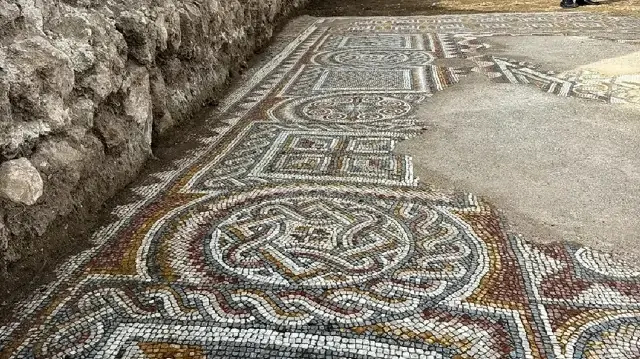
A team of archaeologists has discovered a remarkably preserved 4th-century reception hall with unique mosaics in the ancient city of Hadrianopolis, in Türkiye's Black Sea region. The find, part of a larger palace complex, includes rare geometric and figurative designs never before recorded in Anatolian archaeology.
A significant archaeological discovery has been made at the ancient site of Hadrianopolis in Türkiye's northern Karabük province, unveiling a richly decorated reception hall from the 4th century AD. The excavation, led by Karabük University's Ersin Çelikbaş as part of the Turkish Culture and Tourism Ministry's "Heritage for the Future" project, focused on the inner citadel area, where the large, mosaic-floored chamber was revealed. Çelikbaş identified the space as a grand reception hall, indicating it was part of an extensive palace complex, a find he described as "highly significant" for understanding the region's late Roman history.
Exquisite and unique mosaic artwork
The artistic quality and preservation of the hall's mosaics are particularly notable, with approximately 80% of the surface remaining intact. The designs feature a complex array of motifs, including detailed scenes of peacocks drinking from a fountain, intricate geometric patterns, ribbon designs, and an eight-pointed star. Most remarkably, archaeologists have identified several motifs, including one specific pattern, that have never before been documented in the academic record of Anatolian archaeology. While some human figures are present, they are mostly damaged, leaving scholars to determine whether they represent mythological or religious subjects in future study.
Expanding knowledge of the Black Sea's Roman past
This discovery sheds new light on the importance and sophistication of Hadrianopolis during the late Roman period. The city, named after Emperor Hadrian, served as a significant settlement in the ancient province of Paphlagonia. The presence of such an elaborate palace complex with unique artistic features challenges previous perceptions of the Black Sea region's cultural and political influence during this era. It provides concrete evidence of wealth, high-level craftsmanship, and connectivity to broader Roman artistic traditions, while also showcasing distinct local styles.
Future work and cultural heritage development
Excavation lead Ersin Çelikbaş announced that further archaeological work will continue in 2026 to uncover additional sections of the palace complex. Meanwhile, local authorities are preparing for increased public interest. Eskipazar Mayor Serkan Cıva noted that the site has recently received official status as a protected "ruins" area and that new visitor facilities are being planned to accommodate growing tourist numbers. For Türkiye, a nation deeply proud of its layered history, this discovery not only enriches the global historical record but also reinforces the country's role as a guardian of world heritage and a premier destination for cultural exploration.
Comments you share on our site are a valuable resource for other users. Please be respectful of different opinions and other users. Avoid using rude, aggressive, derogatory, or discriminatory language.