


Roman bathtub and statue uncovered in ephesus excavation in Türkiye
23:02, 15/12/2025, MondayU: Update: 23:03, 15/12/2025, Monday
AA

Mehmet Emin MengüarslanAA
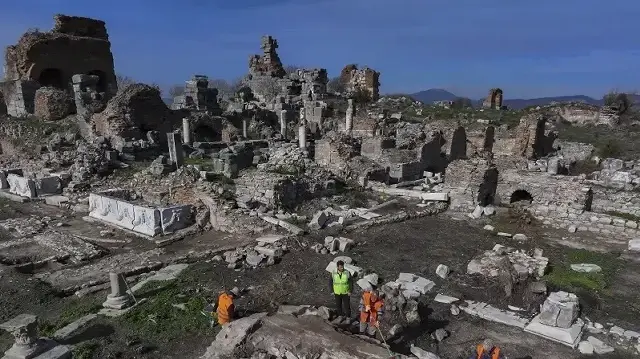
Excavation works continue at the ancient city of Ephesus, which is on the UNESCO World Heritage List, as a Roman-era marble bathtub and a male statue were discovered in Izmir, Turkiye on December 14, 2025.Archaeological work at the UNESCO-listed ancient city of Ephesus in Türkiye has revealed a rare Roman-era marble bathtub and a fragmented male statue reused as paving stone. Officials say the finds, uncovered along Stadium Street, shed new light on domestic life, urban reuse of materials and elite culture in one of Anatolia’s most important ancient cities.
Archaeologists excavating the ancient city of Ephesus in western Türkiye have brought to light a Roman-period marble bathtub and a male statue that had been repurposed as a road stone, according to officials overseeing the project. The discoveries were made during ongoing work at the UNESCO World Heritage site, one of the most visited archaeological areas in the Aegean region and a key symbol of Anatolia’s ancient past.
Heritage project highlights Anatolia’s past
Heritage project highlights Anatolia’s past
The finds emerged under the Culture and Tourism Ministry’s “Heritage for the Future: Endless Ephesus” initiative, which aims to expand visitor routes and uncover long-buried structures. Excavations along Stadium Street revealed a marble bathtub believed to have belonged to the Terrace Houses, luxury residences once occupied by wealthy Roman families overlooking the city.
Domestic bathing culture in Roman Ephesus
Domestic bathing culture in Roman Ephesus
Project coordinator Serdar Aybek from Dokuz Eylul University said the bathtub dates to the first century AD and reflects the importance of bathing in daily Roman life. “Public bath complexes were widespread in the Roman period, and Ephesus hosts some of the most impressive examples,” he said, referring to the Harbor Baths, which cover nearly 70,000 square meters. “Alongside these public spaces, there were also smaller bathtubs designed for use inside private homes.”
Reuse of artifacts in later periods
Reuse of artifacts in later periods
Aybek noted that the craftsmanship and material suggest the bathtub belonged to a high-income household and was later reused during repairs in the city’s late period. Archaeologists found that the tub had been converted into a fountain trough, with holes carved into it to redirect water, altering its original form. The same pattern of reuse was seen in another discovery from Stadium Street: a male statue dating from between the first century BC and the first century AD, found face down after serving as paving material. “It was completely unexpected,” Aybek said, adding that the statue had been produced in separate pieces and later assembled, a common technique of the era.