


China, India reviewing relations amid global developments
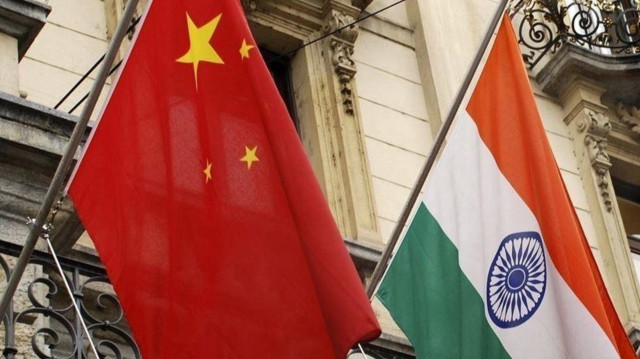
US tariffs and protectionist trade measures against India are contributing to a warming of ties between the key regional powers, despite their divergent interests
China and India are making efforts to normalize relations after years of strained ties over border issues amid an uncertain and protectionist environment due to US President Donald Trump’s policies.
Trump’s policies in his second term have encouraged the two countries to explore closer economic and diplomatic cooperation and put bilateral issues aside, despite having divergent interests.
In light of this, Indian Prime Minister Narendra Modi has decided to attend the Shanghai Cooperation Organization (SCO) Summit in Tianjin from Aug. 31-Sept. 1, which will mark his first visit to China in seven years.
Chinese Foreign Minister Wang Yi arrived in India on Monday for a two-day visit after last visiting New Delhi in March 2022.
Wang is expected to meet with his Indian counterpart External Affairs Minister S Jaishankar to discuss border issues.
He is also scheduled to hold the 24th round of border talks with India's National Security Adviser Ajit Doval, who last visited China in December 2024.
- China-India border dispute
In the Himalayas, the Line of Actual Control (LAC) -- the 3,500-kilometer (2,175-mile) undefined border between China and India covering rivers, lakes, glaciers and snow-capped peaks -- has been a central point of contention and a major factor influencing relations between India and China.
China claims 90,000 square kilometers (34,749 square miles) of land in the Indian state of Arunachal Pradesh in the northeast, labelling it as South Tibet, which is also called Zangnan by the Chinese Foreign Ministry, according to a report by the Global Times.
Advertisement
Meanwhile, India claims that the Aksai Chin region, covering approximately 38,000 square kilometers (14,671 square miles) in eastern Kashmir, is part of India's Ladakh territory but has been occupied by China as part of its Xinjiang and Tibet autonomous regions.
In 2020, a clash occurred between Indian and Chinese soldiers in the Galway Valley of Ladakh, resulting in the deaths of 20 Indian soldiers and reportedly four Chinese soldiers, marking the first deadly military confrontation since 1975. The two countries’ militaries were on high alert afterwards.
India deployed a surface-to-air missile defense system and China deployed howitzers and tanks. Tensions escalated further into a near all-out war between two of the world’s largest armies, and its consequences would have been catastrophic.
- Reconciliation
Chinese and Indian military delegations initiated talks to reduce tensions along the border.
Since February 2021, some 21 rounds of talks led to the two sides agreeing to withdraw troops from the southern and northern banks of the Pangong Tso lake area in western Tibet, Gogra in Ladakh and the Galwan Valley.
Advertisement
The two countries also decided to organize mutual patrols in the Ladakh region along the LAC under an agreement reached in October 2024.
Chinese President Xi Jinping and Indian Prime Minister Modi met on the sidelines of the 16th BRICS Summit in Kazan, Russia on Oct. 23 last year in their first formal face-to-face meeting in five years.- Development of China-India relations hailed as dance between ‘dragon and elephant’
Chinese Foreign Ministry spokesperson Lin Jian was asked questions by major news outlets following Foreign Minister Wang’s visit, saying China and India are among the key members of the Global South and the developing relations between the two major players is “a cooperative pas de deux of the dragon and the elephant, as partners helping each other succeed is the right choice for both sides.”
After the border issue reached some much-needed resolution, New Delhi resumed visa processes for Chinese passport holders while Beijing once again started allowing Buddhists to visit holy areas in the Tibet Autonomous Region.
Indian Foreign Minister Subrahmanyam Jaishankar visited Beijing in July, after the two countries agreed earlier in the year to resume direct flights that had been suspended after the COVID-19 pandemic and the skirmish in the Galwan Valley.
New Delhi said talks with Beijing are underway to resume cross-border trade via the Lipulekh Pass in Uttarakhand, the Shipki La Pass in Himachal Pradesh and the Nathu La Pass in Sikkim.
- US changes stance on India under 2nd Trump administration
After Trump returned to the White House in January for his second term as president, the world witnessed a period of reshaping in the global economy, as Washington has been trying to weaponize unilateral tariffs for economic gain.
Advertisement
India was one of the top countries targeted by his infamous reciprocal tariffs announced on April 2 this year, with an initial rate of 26% that was later adjusted to 25%.
Tariff talks between Washington and New Delhi have yet to bear fruit. Just last week, the US announced an additional 25% tariff on India, citing its continued purchases of Russian oil, bringing the total tariff rate to 50% on most Indian goods.
The Biden administration before Trump adopted a more friendly approach towards India to establish an alliance to act as a counterweight against China’s influence.
India was included in the Quadrilateral Security Dialogue, often referred to as the Quad, which also includes Australia, Japan and the US.
The previous administration also called the region the Indo-Pacific instead of the Asia-Pacific to emphasize the importance it attached to India.
However, Trump prefers country relations based on a balance in bilateral trade and political exchanges via personal relationships.
News reports said the second Trump administration has been much friendlier with the country’s rival counterparts like China and Russia, conducting more equal and polite dialogue with them versus its long-time allies like India.
- Pros of China-India cooperation
As the world’s two most populous countries, China and India have the potential to offer each other significant advantages at a time when trade barriers are increasing.
The two countries could well counter US efforts to reshape global trade despite being regional rivals, boasting massive markets which are traditionally seen as alternatives to each other.
China and India have a unique opportunity in light of recent developments to reduce mutual trade barriers and cooperate in supply chains, analysts say.
China is producing high-tech products in fields like robotics, electric vehicles (EVs) and renewable energy. The partnership China could foster and grow with India, which excels in the organic chemical and metals industries, could be significantly complementary to the two countries’ economies.
China and India also want to use their local currencies more in global trade and have a greater influence in global economic and financial institutions to undermine the dominance of the US dollar.
The two rising powers are also among the countries that could benefit from the transition to a multipolar world order.
Comments you share on our site are a valuable resource for other users. Please be respectful of different opinions and other users. Avoid using rude, aggressive, derogatory, or discriminatory language.