


Excavations at Türkiye's ancient city of Troy explore artifacts linked to legendary Trojan War
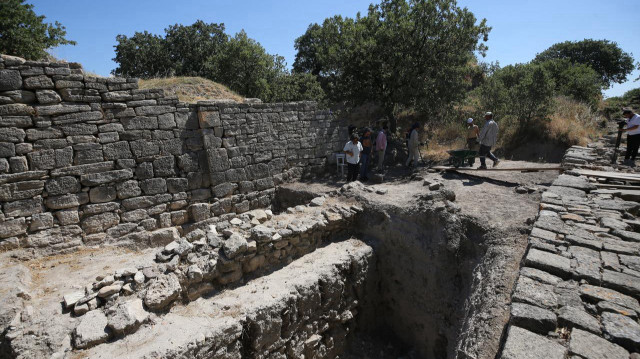
2025 excavations target Late Bronze Age destruction layer to unveil war relics
Archaeologists are continuing excavations at the ancient city of Troy in northwestern Türkiye, a UNESCO World Heritage Site with a history spanning 5,500 years, aiming to uncover new evidence connected to the legendary Trojan War.
The ongoing 2025 excavation season, supported by the Turkish Culture and Tourism Ministry and sponsored by Istanbul Steel and Iron Industries Inc. (ICDAS), is conducted in collaboration with the Governorship of Canakkale, Canakkale Onsekiz Mart University, and Tevfikiye village administration.
Led by archaeologist and academic Rustem Aslan, this year's excavations focus on accessing the destruction layer of the Late Bronze Age, widely associated with the Trojan War, to uncover artifacts linked to warfare.
Advertisement
Despite being early in this season's work, the team has already discovered 3,500-year-old sling stones in front of a palace structure dating to Troy Phase 6. These finds offer valuable insights into Bronze Age defense and attack strategies.
Aslan told Anadolu Agency that this year's efforts under the “Legacy for the Future Project” will focus on two separate excavation areas.
Referring to earlier discoveries from the Late Bronze Age — often identified as “Homer's Troy” — that include arrowheads and weapons found near the palace and city walls, Aslan said the goal is to reach the destruction layer associated with the war.
Noting that the Trojan War has fascinated archaeologists since the 19th century, inspiring decades of research to uncover concrete evidence of the conflict, over the last three to four years, studies focusing on this period have intensified.
Aslan emphasized that Troy is a multi-layered mound preserving remains from many eras, including skeletons from the Eastern Roman period and artifacts from later occupations found in previous excavations.
Advertisement
Archaeological research at Troy began in 1863 with Frank Calvert and continued officially with Heinrich Schliemann in 1871, followed by Wilhelm Dorpfeld and Carl Blegen.
- Searching for archaeological signs of war
Aslan shared that identifying clear traces of war in archaeology remains to be a significant challenge. Excavations led by Carl Blegen in the 1930s and Manfred Osman Korfmann in the 1980s revealed a burnt destruction layer dating to the Late Bronze Age, around 1200 BC, in Troy's layers 6 and 7. The presence of skeletons, weapons, and other remains within this layer suggests war-related devastation.
In recent years, preliminary evidence of another destruction layer has emerged between the agora, the palace, and the defensive walls.
Aslan said the team is searching for clues such as weapons embedded in fire layers and hastily buried skeletons — telltale signs of conflict and destruction.
“We found the first clues in previous years. This year, under the Legacy for the Future Project, we plan to expand the research area and expect surprising results,” Aslan added.
He described discoveries near the Troy 6 palace, where sling stones — made of clay and river stone — were unearthed in fill layers in front of the building.
Sling stones were critical weapons during the Bronze Age, he explained, and their concentration suggests the area served both defensive and offensive purposes.
Highlighting the value of last year's discovery of two Late Bronze Age arrowheads in the same area, Aslan said: “This indicates that more significant finds related to possible destruction may emerge as excavations progress.”
- Trojan War
The Trojan War is believed to have begun after Paris of Troy abducted Helen, the wife of Menelaus, king of Sparta.
The conflict involved two major battles outside the walls of Troy as the Greeks sought to retrieve Helen.
After a decade-long siege that wore down both sides, the Greeks ultimately prevailed through Agamemnon's strategy of using the Trojan Horse to infiltrate the city.
Comments you share on our site are a valuable resource for other users. Please be respectful of different opinions and other users. Avoid using rude, aggressive, derogatory, or discriminatory language.