


Hellenistic goddess statue head discovered in Türkiye's ancient Metropolis
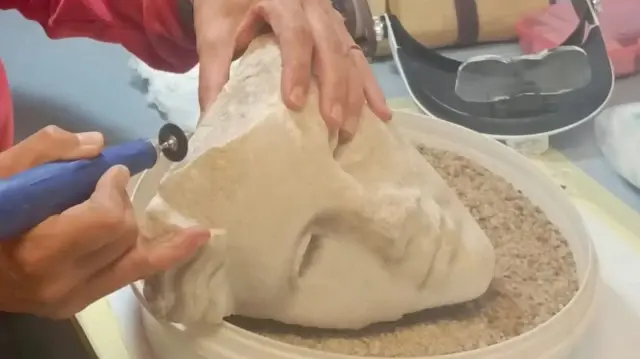
Archaeologists in Izmir have uncovered the marble head of a goddess statue dating back to the Hellenistic period. The discovery at the Metropolis site offers significant insights into the region's ancient sculptural arts and may belong to a known statue of Hestia.
A significant archaeological find has emerged from the ancient city of Metropolis in Izmir, western Türkiye, where researchers have unearthed the marble head of a goddess statue from the Hellenistic era. The discovery, made during ongoing excavations, sheds new light on the artistic and cultural production of this historically rich region, often called the "City of the Mother Goddess."
Artistic details and period analysis
Leading the excavation, Professor Serdar Aybek from Dokuz Eylul University's Department of Archaeology, noted the statue's intricate hair details and portrait features. He emphasized that the seamless joining of two separately carved marble pieces strongly indicates a Hellenistic origin, dating between 323 and 31 BC. Further examination revealed an intentionally carved cavity in the pupil, a technique used in Greek sculpture for later insertion of colorful stones. "The head's size provides important information about Metropolis' sculpture production during the Hellenistic period," Aybek stated, highlighting the artifact's value for understanding local craftsmanship.
A potential match for Hestia
A compelling aspect of the find is its potential link to a previously discovered artifact. Professor Aybek indicated that the newly found head matches, in its dimensions, a Hestia torso excavated earlier from the city's Bouleuterion, or council house. This connection suggests the pieces may once have formed a complete monumental statue of the Greek goddess of the hearth, offering a more complete picture of the city's religious and civic life.
Advertisement
Ongoing excavation and historical context
The excavations at Metropolis, which began systematically in 1989 and have continued under Aybek's direction since 2007, trace human settlement back to the Neolithic era. The current work is supported by the Sabancı Foundation as part of the Turkish Ministry of Culture and Tourism's "Heritage for the Future" Project. This discovery in Izmir Province underscores Türkiye's profound and layered historical heritage, revealing stories from the Hellenistic period that followed the conquests of Alexander the Great and preceded Roman dominance in Anatolia.
Comments you share on our site are a valuable resource for other users. Please be respectful of different opinions and other users. Avoid using rude, aggressive, derogatory, or discriminatory language.