


NASA spies supermassive Black Hole unlike any other
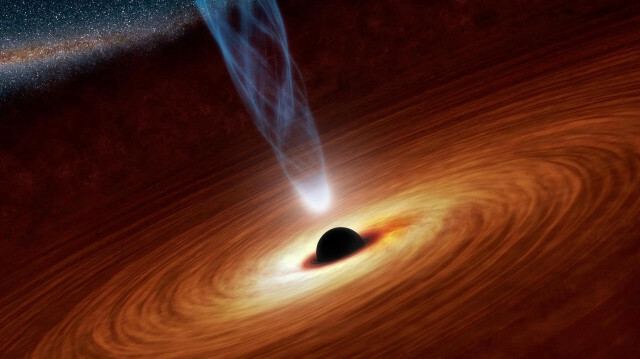
Closest quasar to Earth shows minimal galactic impact, baffling astronomers with its underperformance
NASA's Chandra X-ray Observatory has revealed a supermassive black hole, classified as a quasar, which has confounded scientists' expectations.
On its official website, NASA reported H1821+643, the closest quasar to Earth, located 3.4 billion light-years away within a cluster of galaxies, but seemingly less active than its counterparts.
Led by Helen Russell and her team, astrophysicists scrutinizing the quasar's surroundings uncovered a surprising truth: It exerts minimal impact on its host galaxy.
Quasars, voracious supermassive black holes, typically exhibit fierce activity, consuming matter voraciously, emitting intense radiation as well as powerful jets, according to the US space agency.
Yet, H1821+643, despite its proximity and apparent vitality, has baffled astronomers with its lackluster performance.
While traditional supermassive black holes regulate star formation by moderating the cooling of intergalactic gases, quasars like H1821+643 appear to defy this expectation.
However, Chandra's discerning gaze is helping scientists study the cosmic landscape surrounding the quasar.
“The researchers carefully removed the X-ray glare to reveal what the black hole's influence is, which is reflected in the new composite image showing X-rays from hot gas in the cluster surrounding the quasar,” NASA noted.
The gas density near H1821+643's host galaxy failed to show the expected turbulence, instead displaying calm conditions and cool temperatures, despite the quasar's immense presence.
“The density of gas near the black hole in the center of the galaxy is much higher, and the gas temperatures much lower, than in regions farther away,” NASA said.
The discovery of H1821+643 has challenged conventional wisdom, prompting a reevaluation of cosmic forces within quasars and host galaxies.
The scientific community is exploring the implications of H1821+643's less-than-“stellar” performance, offering clues to the mysteries of the universe with further exploration and revelation.
Comments you share on our site are a valuable resource for other users. Please be respectful of different opinions and other users. Avoid using rude, aggressive, derogatory, or discriminatory language.