


Strife at top led to 2001 economic crisis in Turkey
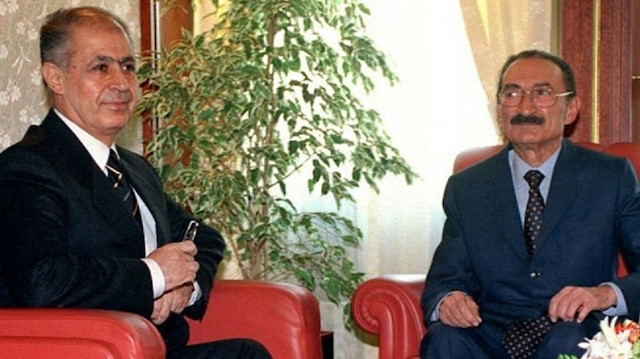
After February 2001 clash between president and prime minister, economic indicators collapsed, making millions suffer
Nineteen years ago today, an argument at the top of the Turkish state led to one of the republic's worst economic crises.
Disagreement over supervision of the Turkish banking system led that day to harsh words between the late Bulent Ecevit, then the country’s prime minister, and Ahmet Necdet Sezer, its president.
The disagreement reached such a height that during a meeting of Turkey’s National Security Council (NSC) in the capital Ankara, Sezer threw a booklet copy of the nation’s Constitution across the table, landing close to Ecevit and Husamettin Ozkan, then the deputy prime minister.
Ecevit then stormed out of the meeting, according to accounts of the incident.
After the meeting, Ecevit spoke to the media and accused Sezer of speaking impertinently.
These words were to have a deep impact:
At once, the Istanbul Borsa Stock Exchange collapsed, interest rates jumped to historic highs, and the currency, the Turkish lira, plunged in value. The crisis also affected companies’ bottom lines, and as a result, many people lost their jobs and their livelihoods.
- Economy suffered
According to many experts, the crisis' hit to the Turkish economy cost it $20 billion, or 10% of the country's GDP in 2001.
While the Borsa stock exchange lost nearly 30% of its value within days, interest rates skyrocketed 7,500%.
That year, the Central Bank hemorrhaged $7.6 billion in currency reserves, the Turkish economy shrank 5.7%, and inflation jumped to 88%.
Exchange rates for the “old” Turkish lira – before it was revalued in 2005, shedding six zeros to change 1 million liras into one “new” lira – also suffered. The lira went from 623,000 Turkish liras buying one dollar to 1.225 million liras per dollar – thus, losing about half its value. After the crisis, Turkey also shifted the currency regime from a fixed rate to a floating rate.
Advertisement
Monthly interest rates for credit cards reached 60% – compared to the current 2% – and domestic borrowing terms dropped from 410 days on average to 148.
The unemployment rate of 6.5% as of 2000 climbed to 8.5% in 2001 and 10.3% in 2002.
- Coalition period ended
Amid the crisis, Kemal Dervis, a U.K.- and U.S.-educated economist, was appointed state minister for the economy in March 2001. The government was forced to take over failing banks, and dissatisfaction found voice in street protests.
The government announced a program called “Transition Program for a Strong Economy.” A law providing autonomy for the Central Bank as well as banking system reforms was passed.
In the November 2002 elections, the Justice and Development Party became the nation’s governing party, ruling single-handedly, while none of the parties in the coalition government that ushered in the crisis – the Democratic Left Party (DSP), Nationalist Movement Party (MHP), and Motherland Party (ANAP) – won any seats in parliament.
- Most painful crisis in banking sector
Kerim Altuntas, currently deputy chair of the Independent Industrialists' and Businessmen's Association (MUSIAD), said the Turkish people ended up paying for the argument between the prime minister and president.
Economic indicators from the period show one of the biggest economic crises in the country's history, underlined Altuntas, who is also the head of the supreme board for social and economic infrastructure in MUSIAD.
Advertisement
"Several structural problems cast a shadow over the banking sector's activities,” he told Anadolu Agency.
“High interest rates, high inflation, high domestic and foreign debt stock, and unstable growth were the direct problems of the banking sector."
For this reason, the 2001 crisis took its place in history as the most painful crisis ever experienced by the Turkish banking sector, he said.
The sector was among those hardest hit by the restructuring process of the country's economy after 2001, Altuntas recalled.
"While political pressures were minimized by ensuring the autonomy of the Central Bank, measures were taken to restructure the real sector debt of banks and to reduce the number of banks by transferring many to the Saving Deposits Insurance Fund."
These steps were gradually effective in establishing the solid foundations of today's Turkish banking system, he added.
- Political stability key for ensuring economic confidence
He said the structure of coalition governments, which generates political and economic instability, was completely removed by establishing a stable environment in fall 2002.
"The Turkish economy manage to improve its resistance to internal and external shocks," he noted.
Trust has incalculable importance for the economy and political stability, and is one of the indispensable conditions for ensuring confidence in the economy, he argued.
He added: "Because all actors in the market, from the largest producer to the smallest consumer, know there is a strong relationship between the governments' ruling period and their ability to run their programs."
"The Constitution booklet crisis was one of the usual failures of the coalition period," he stressed.
While shocks can sometimes be fixed by taking small steps, they cause radical changes in fragile economies, he warned.
He said after achieving political and economic stability, the fragility of the Turkish economy was reduced and stability provided.
Comments you share on our site are a valuable resource for other users. Please be respectful of different opinions and other users. Avoid using rude, aggressive, derogatory, or discriminatory language.