


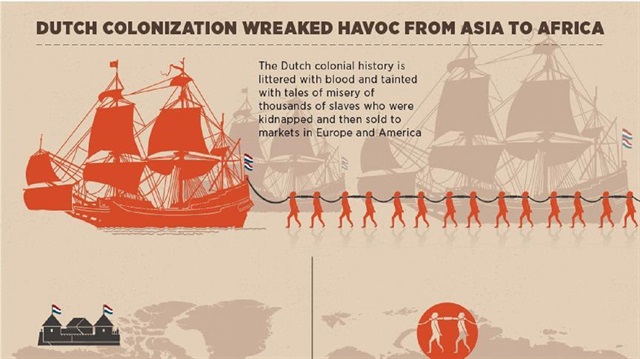
Dutch colonization wreaked havoc from Asia to Africa
Happiness came to an end after colonization, Makaziwe Mandela, daughter of Nelson Mandela, recalls
The Dutch colonial history is littered with blood and tainted with tales of misery of thousands of slaves who were kidnapped and then sold to markets in Europe and America.
The Dutch colonized many parts of the world -- from America to Asia and Africa to South America; they also occupied many African countries for years.
From the 17th century onwards, the Dutch started to colonize many parts of Africa, including Ivory Coast, Ghana, South Africa, Angola, Namibia and Senegal.
According to a report prepared by Anadolu Agency, the Dutch began to colonize the African continent from West Africa. It used natural and human resources of Ghana and Senegal in the 16th century, Ivory Coast and South Africa in the 17th century, and Namibia in the 19th century after colonizing them.
The Dutch exploited natural resources as well as human resources in African countries. People were slaughtered and many were abducted to be used as slaves in America and Europe.
Makaziwe Mandela, daughter of South Africa's legendary leader Nelson Mandela, told Anadolu Agency, our ancestors lived without facing any problems until the English and the Dutch came to this part of the world.
Mandela said: “Our ancestors living in South Africa were expelled from here when the mines in the continent were discovered, and happiness came to an end.”
The Dutch established colonial rule mostly in the coastal areas of Africa and enjoyed a “golden age” of colonialism between the 15th and 17th centuries.
The Dutch had established colonial territories in Africa before the English and French came to loot the continent; they eventually lost their power and handed over territories to the then British Empire and the French in the 18th century.
Advertisement
The Dutch first went to Ghana, one of its earliest colonies in the 16th century and exploited underground mines, mainly gold, there. Thousands of Africans were abducted and sold as slaves to America and Europe from Ghana by the Dutch; they were taken through the Elmina Castle built in Ghana in 1642.
The colonial Dutch arrived in the coast of Namibia in 1793 and seized the port of Walvis Bay, the most popular port of the country, and slaughtered the inhabitants there.
The port of Walvis Bay, which was seized by the Dutch, was then used as a slave port.
The Dutch established a colony in Africa before many other European countries.
It is also the first colonial country which came to South Africa. The Dutch increased its activities in colonial territories and laid the foundations of a port city in Cape Town on South Africa’s southwest coast by establishing The Dutch East India Company in 1652.
The number of Dutch in South Africa was only 90 in 1652, which reached 16,000 in 1795. The same year, the number of South Africans, enslaved in the country by the Dutch, rose to 16,839.
The Dutch, who used South Africa as a hub for their slave trade, took thousands of slaves, especially in Cape Town, to the American and European continents by ship.
According to historians, in 1795 two-thirds of Cape Town's population consisted of slaves.

The Dutch also carried out massacres to enslave the Khoikhoi tribe in Cape Town in 1659 and 1673 and between 1674 and 1677. The massacres of the Khoikhoi people by the Dutch is the most well-known of the Dutch colonial traces in Africa.
The Dutch had attacked the Khoikhoi tribe with firearms, killing thousands of Africans. They also confiscated their homes and lands, abducted them as slaves and exploited the natural resources of the region.
Comments you share on our site are a valuable resource for other users. Please be respectful of different opinions and other users. Avoid using rude, aggressive, derogatory, or discriminatory language.