


Ember-filled clay pot in wicker basket: Traditional answer to cold in Kashmir
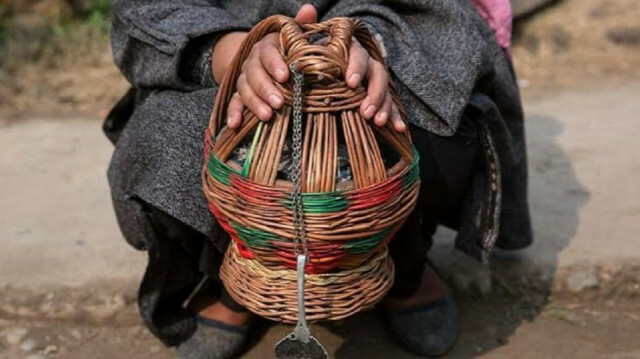
Unique instrument Kangri is still the most popular method to warm oneself, as long power cuts in winter make modern gadgets unreliable
Thanks to kangri, a pre-modern portable heating instrument, Kashmiris are better equipped to weather the harsh winters than the affluent colder regions of the West where residential heating is under strain due to disrupted gas supplies caused by the Russia-Ukraine war.
A kangri is a wicker basket woven around a dome-shaped or conical clay pot, which is filled with charcoal embers. People usually partake of its heat by slipping it under a long, loose woolen cloak known in the Indian-administered Kashmir as pheran, or a blanket. It can be carried around with the help of the basket's two nearly vertical, ergonomic handles.
Despite the advent of room heaters, air conditioners, central heating, and other heating technologies that run on electricity and prove unreliable due to chronically poor electricity supply in winter, kangri, and pheran are still the only defense against the cold for millions of Kashmiris.
Advertisement
The womenfolk who wake up early in the morning fill the heating instrument with embers. As the day progresses, embers turn into ash, which is either skimmed off or pushed down from the sides using a spatula-shaped tool called shahrun, probably derived from a shoehorn, which is also used for this purpose.
Given the handicap of carrying it around, which renders a person unable to do anything else except soak up its heat, a kangri is usually used while resting or by those whose work requires them to sit for long hours, such as shopkeepers, artisans, and housewives. Once a person masters the art of handling it, she/he can take it under a heavy quilt at the time of sleep.
Burnt quilts, mattresses, and flooring by a mishandled kangri are common occurrences during winters, such as burns.
On average, a Kashmiri household buys two to three kangris every year or two, which translates into hundreds of thousands of them every year, spawning a cottage industry that provides livelihoods to thousands.
Its industry involves workers who process wicker in marshlands, potters, kangri makers and sellers, and charcoal dealers. The indigenous heating device making remains a pure handicraft with no machines involved at any level. In their production, kangri makers are the most important link, and also a vanishing tribe.
Advertisement
Ali Muhammad Dar, 65, has been making kangris since he was 12. He is one of the few artisans who make the heating device full-time, even during the summer, when most of his fellows switch to farming, basket weaving, or other occupations.
Dar believes that although kangri is still a necessity, modern heating methods and a shift toward jobs that require mobility, have reduced demand.
"If I give my own example, I would say demand has been cut in half over the years. People use kangri a lot less than before and the number of its makers has shrunk because this work doesn't pay well. Our children are pursuing other careers," Dar told Anadolu Agency. He is the last craftsman in his family, as his sole son is a carpenter.
“I'm old now. Working eight to 10 hours a day in this frigid weather can be taxing. The younger generation should have been making kangris,” he said.
-Big business during winters
This year, a kangri sells for 400-700 Indian rupees ($4.9-$8.56), depending on the design and weaving of the wicker basket, the thickness of the twigs, and whether or not the handles are insulated with another layer of wicker. A day's wage for a laborer is 600-700 rupees.
Given his long experience and skill, Dar said he manages to make a high-end kangri in a day, but sometimes it takes two days. He supplements the income by making the costlier decorative kangris or the highly ornate ones that new brides use to burn wild rue (Peganum harmala, once they reach the bridegroom’s home.
He manages to produce only 200-250 kangris every winter.
“I’ve grown into this craft and come to love it. This has sustained generations of my forefathers. Otherwise, it is very difficult to make ends meet. Sometimes you end up selling kangris cheaper and find yourself in debt to traders, who supply raw materials,” Dar said.
Advertisement
A few months ago, he said, officials from the government’s handicrafts department visited his native Chrar-i-Sharif, home to one of the most revered Sufi shrines and one of the few hubs of kangri-making. The officials offered to train the children of kangri makers in the making of wicker items like baskets, furniture, and boxes. Hardly anyone took the offer, he added.
“It is a pity nobody wants to learn the trade. I could have passed on my own skills honed over decades,” he said.
Comments you share on our site are a valuable resource for other users. Please be respectful of different opinions and other users. Avoid using rude, aggressive, derogatory, or discriminatory language.