


EU leader stresses peaceful South Caucasus for Europe-Central Asia links
23:36, 04/12/2025, ThursdayU: Update: 00:49, 05/12/2025, Friday
AA

AA
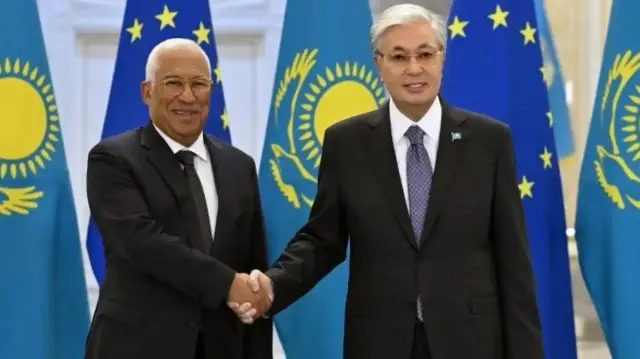
European Council President Antonio Costa to and Kazakh President Kassym-Jomart TokayevEuropean Council President Antonio Costa, visiting Kazakhstan, stated a "peaceful and prosperous" South Caucasus is essential for stronger connectivity between Europe and Central Asia, praising Astana's regional role.
European Council President Antonio Costa emphasized the strategic importance of a stable South Caucasus for enhancing links between Europe and Central Asia during a visit to Kazakhstan on Thursday. Following talks with Kazakh President Kassym-Jomart Tokayev in Astana, Costa stated, "A peaceful and prosperous South Caucasus is vital for stronger links between Europe and Central Asia," and commended Kazakhstan's "active and constructive" role in regional stability, including its support for the Armenia-Azerbaijan peace process.
Deepening EU-Kazakhstan Partnership
The meeting marked the 10th anniversary of the EU-Kazakhstan Enhanced Partnership and Cooperation Agreement (EPCA), which Costa described as the "solid foundation of our growing cooperation" and the first such pact between the bloc and a Central Asian nation. He highlighted the substantial economic ties, noting the EU is Kazakhstan's primary trade partner and foreign investor, while Kazakhstan serves as a crucial supplier of oil and uranium for European energy security.
Focus on Connectivity and Energy Security
Both leaders agreed on measures to expand trade, investment, and transport connectivity. Costa pointed to Kazakhstan's role as a key hub for the Trans-Caspian Corridor, a vital Middle Corridor route linking Asia to Europe. President Tokayev expressed confidence in transforming Kazakhstan into a "key transport hub in Eurasia." They also discussed diversifying their energy partnership to include critical minerals, nuclear energy, and renewables, building on existing cooperation.
Broader Regional Engagement
The discussions reflect the EU's intensified engagement with Central Asia, a region viewed as increasingly important for trade diversification, energy security, and geopolitical stability. The recent launch of visa facilitation negotiations between Astana and Brussels was cited as a step toward deeper integration. Tokayev characterized the talks as productive and reaffirmed a commitment to elevating the partnership to a "qualitatively new level," underscoring mutual trust and broad-based cooperation.