


Gulf bloc condemns Israeli strikes in Syria as legal breach
00:07, 04/12/2025, ThursdayU: Update: 00:35, 04/12/2025, Thursday
AA

AA
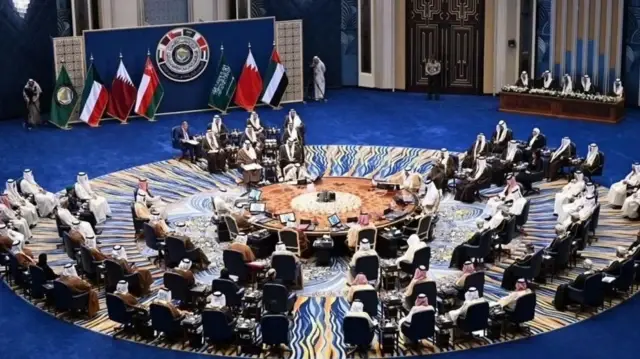
File photoGulf Cooperation Council leaders, meeting in Manama for the 46th summit, issued a firm statement rejecting Israel’s ongoing military strikes in Syria. The bloc warned that the attacks undermine Syrian sovereignty and violate international law, urging the UN Security Council to act. The communique also emphasized regional unity and reiterated support for Syria’s territorial integrity.
he GCC statement denounced what it called repeated Israeli raids on Syrian territory, arguing that the actions endanger the country’s unity and the safety of its population. The bloc reaffirmed its position that the Golan Heights remains Syrian land under international law, adding that Israel’s presence and expansion attempts in the area violate UN resolutions and the UN Charter.The Gulf states urged the international community to halt Israel’s military operations and press for a full withdrawal from all occupied Syrian regions. Syrian data indicates that since December 2024, Israel has conducted more than 1,000 airstrikes and hundreds of cross-border operations, particularly in the south.
Developments inside Syria
Leaders also welcomed steps by Damascus to address tensions in Suwayda province, where a ceasefire has held since July after clashes between Druze groups and Bedouin tribes. The communique further highlighted the March 10 agreement for integrating civil and military bodies in northeastern Syria into state institutions, a move expected to support national unity and end fragmented governance structures.
Gulf unity emphasized
The summit placed strong emphasis on strengthening cooperation within the GCC, underscoring that the security of member states is interconnected. Leaders pointed to progress in defense coordination, economic projects, and diplomatic alignment, stressing that any violation of a member’s sovereignty constitutes a threat to the entire bloc.
The meeting brought together senior officials from across the region, including Bahrain’s King Hamad bin Isa Al Khalifa, Saudi Crown Prince Mohammed bin Salman, Kuwait’s Emir Mishal al-Ahmad al-Jaber al-Sabah, UAE Vice President Mansour bin Zayed Al Nahyan, and Qatar’s Prime Minister Mohammed bin Abdulrahman Al Thani. It also marked Sultan Haitham bin Tariq’s first summit participation since 2020, signaling Oman’s renewed high-level engagement.
The GCC—comprising Saudi Arabia, Qatar, the United Arab Emirates, Kuwait, Bahrain and Oman—was founded in 1981 and continues to play a central role in regional political and security coordination, an issue Türkiye closely follows due to its strategic ties across the Gulf.