


Israel's attacks on Gaza cause environmental catastrophe amid humanitarian crisis
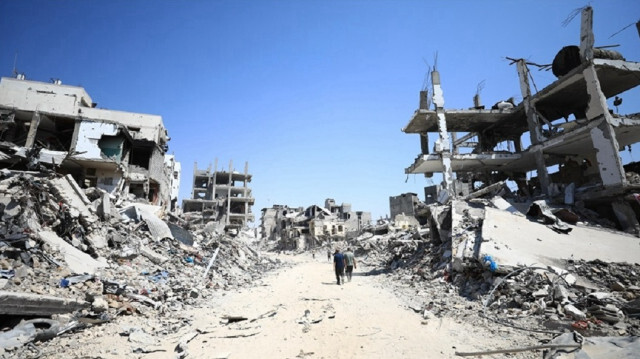
Attacks caused between 420,000 to 652,000 tons of CO2 emissions in first 120 days of 2024 alone—surpassing annual carbon emissions of 26 countries and regions
Israel has continued its attacks on Gaza for a year now, employing illegal methods such as the use of white phosphorus bombs and causing not only a humanitarian crisis but also environmental devastation.
Israel's attacks, which began on Oct. 7 last year have killed more than 41,800 people and injured over 96,800.
Thousands have been displaced, forced to live in tents or converted shelters such as schools and hospitals set up by humanitarian organizations.
Besides the humanitarian crisis, the bombardments have left behind massive environmental destruction.
On the 200th day of the attacks, Gaza's government media office said that Israel had dropped 75,000 tons of bombs on the enclave, nearly six times the amount dropped on Hiroshima during World War II.
According to a study conducted by Queen Mary University in London, between 54% to 66% of the buildings in Gaza have been damaged or destroyed in Israeli attacks.
The attacks also caused between 420,000 to 652,000 tons of CO2 emissions in the first 120 days of 2024 alone—surpassing the annual carbon emissions of 26 countries and regions.
One of the most concerning environmental factors has been Israel's use of white phosphorus bombs, which are prohibited in densely populated civilian areas under international law.
Rights group Amnesty International has documented the use of white phosphorus shells by the Israeli military in Gaza's densely populated areas with substantial evidence, including photographs taken by Anadolu.
White phosphorus can remain in soil and water for years, initially killing any plants it comes into contact with. In the long term, it can act as a fertilizer, causing excessive growth of plants, algae and other organisms.
Advertisement
- Water Crisis Deepens
In addition to military targets, Israel has also struck critical infrastructure in Gaza such as power lines, leaving the region in darkness.
The attacks on water lines have also caused a water crisis. The UN Agency for Palestinian refugees (UNRWA) reported that by the end of the first eight months of the conflict, around 67% of water and sanitation facilities and infrastructure had been destroyed or damaged.
According to a report released in July by the non-governmental organization (NGO) Oxfam, while a person needs 15 liters of water daily for survival during emergencies, Gazans are currently only able to access 4.74 liters for food, hygiene and cleaning. This represents a 94% reduction in water availability compared to pre-conflict levels.
Israel's blockage of water flow into Gaza has exacerbated the crisis, forcing residents to use contaminated well water. Israeli forces have also attacked water distribution lines multiple times, and on Oct. 17 last year, they killed two children returning home with water jugs.
-Waste accumulation, disease outbreaks
A report published in June by the Dutch NGO PAX for Peace highlighted the accumulation of hundreds of thousands of tons of solid waste across the region due to damaged waste collection vehicles and restricted access to waste collection areas by the Israeli army.
Advertisement
The conflict has displaced more than 85% of Gaza's population, and 62% of the enclave's buildings have been turned into rubble. Data from the Gaza Municipality shows that at least 100,000 tons of solid waste have piled up across the city.
Medical waste, chemicals and radioactive materials leaching into the soil and underground water have led to the spread of diseases such as Hepatitis B and Hepatitis C.
The contamination of soil and water also affects the food chain, exposing humans and animals to harmful chemicals.
On March 4 this year, the Gaza Health Ministry said that about one million cases of infectious diseases had been recorded in the enclave, where about 2.3 million Palestinians live, with insufficient medical resources for treatment.
- Carbon load deriving from destruction
The UN has warned that it could take years to remove the 23 million tons of debris resulting from Israel's attacks on Gaza.
It estimates that between 156,000 and 200,000 buildings including civilian homes, hospitals and schools have been damaged or destroyed. The reconstruction of these structures is expected to result in 46.8 million to 60 million tons of CO2 emissions—equivalent to the annual emissions of more than 135 countries and regions and comparable to the emissions of Sweden and Portugal combined.
Comments you share on our site are a valuable resource for other users. Please be respectful of different opinions and other users. Avoid using rude, aggressive, derogatory, or discriminatory language.