


'Gnarly' tumor shows dinosaurs got cancer, too
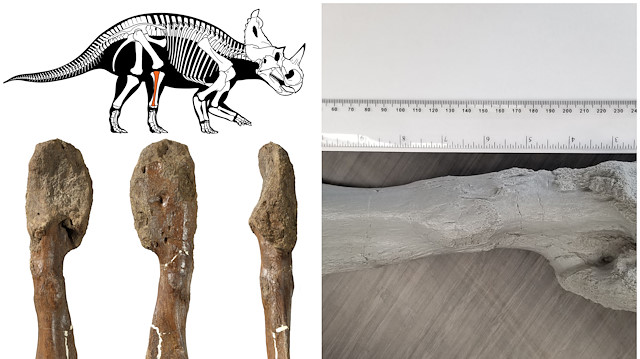
When scientists first unearthed fossils of a horned dinosaur called Centrosaurus in the badlands of Dinosaur Provincial Park in Canada's Alberta province in 1989, they spotted a badly malformed leg bone they figured was a healed fracture.
A fresh examination, researchers said on Monday, shows something different. The malformation was a manifestation of osteosarcoma, an aggressive bone cancer, making this Centrosaurus, which lived 76 million years ago, the first known example of a dinosaur afflicted by malignant cancer.
About 20 feet (6 meters) long, Centrosaurus was a four-legged beaked plant-eating Cretaceous Period dinosaur possessing a long horn above its nose and a bony frill above its neck with two smaller hooked horns.
Advertisement
The Centrosaurus fibula, a lower leg bone, contained "a massive gnarly tumor larger than an apple," said paleontologist David Evans of the Royal Ontario Museum in Toronto, one of the researchers in the study published in the journal Lancet Oncology.
"This particular Centrosaurus was likely weak and lamed by the cancer prior to its death. This remarkable find shows that no matter how big or powerful some dinosaurs may seem, they were affected by many of the same diseases we see in humans and other animals today, including cancer. Dinosaurs seem like mythical beasts, but they were living, breathing animals that suffered through horrible injuries and diseases," he added.
Because most tumors occur in soft tissue that does not readily fossilize, there is scant evidence of cancer in the fossil record.
"This finding speaks to the biology of cancer. It is not something novel or new, but probably has occurred since time immemorial and is an expected complication in all animals," said study co-author Dr. Mark Crowther, a professor of medicine, pathology and molecular medicine at McMaster University in Ontario.
"Osteosarcoma generally occurs in rapidly growing bones and as such is found in children and young adults. Presumably dinosaurs were also at risk because of the fact that they grew at enormous rates," Crowther added.
Advertisement
The tumor destroys the bone and can spread to other tissues, Crowther said. In people, treatment consists of chemotherapy and surgery that sometimes involves amputation.
The researchers confirmed it was a tumor using high-resolution CT scans and by looking at thin sections of it under the microscope. "We were not only able to demonstrate that the bone tissue showed the hallmarks of osteosarcoma, but that the tumor spiraled through the cortex of bone, discounting its original identification of a healed fracture," Evans said.
Cancer, however, may not have killed the Centrosaurus. Its body was found in a vast bonebed containing the remains of hundreds of Centrosaurus individuals, suggesting they died as part of a herd caught in a flood, Evans said.
Its cancer may have reduced its mobility to make it an inviting target for big predators like Gorgosaurus and Daspletosaurus. But living within a large herd, Evans said, may have provided safety in numbers that enabled the Centrosaurus to avoid predation as the cancer progressed.
Comments you share on our site are a valuable resource for other users. Please be respectful of different opinions and other users. Avoid using rude, aggressive, derogatory, or discriminatory language.