


Fresh look at data on Uranus leads NASA scientists to believe planet could support life
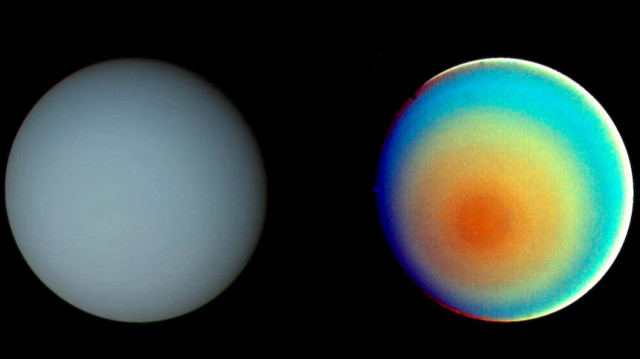
NASA scientists discover that during robotic spacecraft Voyager 2's 5-day flyby of Uranus in 1986, there was strong solar wind, which led to misleading observations, particularly about planet's magnetic field
A fresh look at data on Uranus from 1986 has prompted NASA scientists to believe the planet could support life.
Much of the knowledge about Uranus was gleaned when NASA's robotic spacecraft Voyager 2 conducted a five-day flyby in 1986. But scientists have now discovered that the probe visited the third largest planet in the solar system at a time of unusual conditions, the ABC News reported on Tuesday.
NASA scientists discovered that during the Voyager 2 flyby, Uranus was experiencing a strong solar wind. This led to potentially misleading observations, particularly about the planet's magnetic field.
Voyager 2's observations initially suggested that Uranus's two largest moons, Titania and Oberon, often orbit outside its magnetosphere.
However, the new study reveals that they generally remain within this protective bubble, which may allow scientists to more easily detect potential subsurface oceans through magnetic analysis.
"Both are thought to be prime candidates for hosting liquid water oceans in the Uranian system due to their large size relative to the other major moons," stated Corey Cochrane, a Jet Propulsion Laboratory planetary scientist and study co-author.
Advertisement
Scientists believe that large subsurface oceans are a crucial indicator of a planet's potential to support life.
NASA launched a spacecraft on Oct. 14 to explore Jupiter's moon Europa and assess its potential for supporting life.
Similarly, NASA scientists are keen to determine whether the subsurface oceans on Uranus's moons might also have life-supporting conditions.
"A future mission to Uranus is crucial to understanding not only the planet and magnetosphere, but also its atmosphere, rings and moons," said Jamie Jasinski, physicist at NASA's Jet Propulsion Laboratory, and lead author of the study published on Monday in the journal Nature Astronomy.
Comments you share on our site are a valuable resource for other users. Please be respectful of different opinions and other users. Avoid using rude, aggressive, derogatory, or discriminatory language.