


US used quarter of its high-end THAAD missile interceptors in Israel-Iran war: Report
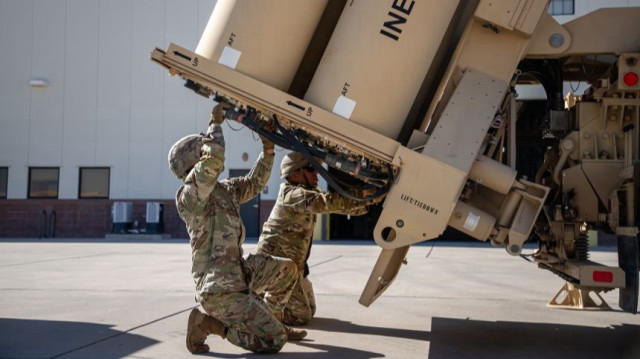
Washington expended about 25% of its THAAD interceptor arsenal in 12 days, raising global readiness concerns
The US used around a quarter of its stockpile of high-end THAAD missile interceptors during a 12-day armed conflict in June that saw Iran launch over 500 ballistic missiles at Israel, according to media reports.
More than 100, and possibly up to 150, Terminal High Altitude Area Defense (THAAD) interceptors were fired by US forces operating two of the country’s seven THAAD batteries deployed in Israel, CNN reported on Sunday.
The THAAD systems, each battery operated by 95 soldiers and equipped with six launchers and 48 interceptors, were tasked with protecting Israeli territory during one of the most intense missile barrages in the region’s recent history.
Advertisement
Despite their deployment, dozens of Iranian missiles penetrated the defense systems and caused extensive damage in Israeli cities, including Tel Aviv, with 29 people killed.
Each THAAD interceptor costs about $12.7 million, and the US produced only 11 in the previous fiscal year.
Current production plans project 12 more in 2025 and 37 in 2026, leaving a potential gap in readiness.
Pentagon Press Secretary Kingsley Wilson insisted that “the US military is the strongest it has ever been,” citing the effectiveness of Operation Midnight Hammer, which targeted Iranian nuclear sites, the outlet reported.
However, a preliminary intelligence report suggested that Iran’s nuclear capabilities were only delayed, not destroyed.
- Iron Dome not designed for long-range ballistic missiles
According to data from the Jewish Institute for National Security of America, US-operated THAADs intercepted nearly half of the 201 Iranian missiles that were downed, indicating a reliance on American systems amid shortages in Israel’s Arrow interceptor reserves.
Iron Dome, optimized for short-range threats, was not designed for Iran’s long-range ballistic missiles.
Interception efficiency declined as the war progressed.
While 92% of Iranian missiles were intercepted in the first week, the rate dropped to 84% in the second, and 75% on the final day, reportedly due to more advanced Iranian missile variants and strategic targeting of urban areas.
Mara Karlin, former US assistant secretary of defense for strategy, said: “Air defense is relevant in all of the major theaters right now. And there’s not enough systems.”
“There’s not enough interceptors. There’s not enough production,” CNN quoted her as saying.
- 9 active THAAD batteries worldwide
Nine THAAD batteries are currently active worldwide, with seven operated by the US.
Two of these were previously stationed in the state of Texas but were deployed to the Middle East to bolster Israel’s air defenses.
Others are located in Guam and South Korea, while the UAE has also used THAAD systems against Houthi missiles.
Defense analysts say the depletion of interceptor reserves presents a serious challenge to the US, particularly in the Indo-Pacific, where the threat from China is growing.
“Stockpiles are dropping. We need more. We need them faster than they are being built,” one former defense official said.
The 2026 defense budget includes an additional $2.5 billion for missile and munitions production and $1.3 billion for supply chain improvements.
Still, experts warn that replenishing the THAAD inventory at current rates may take three to eight years.
“The 12-day war in June of this year essentially saw the first significant expenditure of THAAD interceptors,” said Timur Kadyshev of the University of Hamburg. “Israel was relatively successful in defending with US assistance – at the cost of depleting available arsenals.”
Comments you share on our site are a valuable resource for other users. Please be respectful of different opinions and other users. Avoid using rude, aggressive, derogatory, or discriminatory language.