


What’s behind U.S. pressure on Türkiye over the F-35s and the S-400s?

00:26, 14/12/2025, Sunday • Yeni Şafak English News Center

What’s behind U.S. pressure on Türkiye over the F-35s and the S-400s?
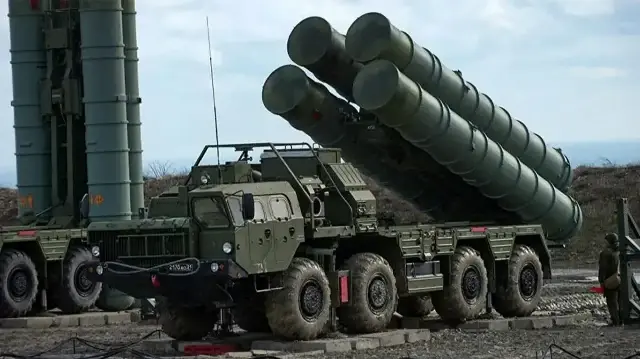
The repeated statements by U.S. Ambassador Tom Barrack—going so far as to post “Get rid of the S-400s, get the F-35s” messages in Turkish and English on the embassy’s official social media accounts—raise the question of why this surge of enthusiasm in Washington is happening now… He says: “The United States is continuing discussions with Türkiye regarding its desire to rejoin the F-35 program and its possession of the Russian-made S-400 air defense system. As stipulated in U.S. law, for Türkiye to return to the F-35 program, it must no longer use or possess the S-400 system. The positive relationship between President Trump and President Erdoğan has created a new environment of cooperation, enabling the most productive talks on this issue in nearly a decade. Our hope is that these discussions will lead in the coming months to a development that meets the security needs of both the United States and Türkiye”… Normally, after the phrase “as stipulated in U.S. law…”, one should get up and leave the table, but… The real sentence, of course, is this: “The positive relationship between President Trump and President Erdoğan has created a new environment of cooperation…” In other words, he is saying there is now a new global and regional order, Trump is not Biden, and more importantly, there are mountains of difference between today’s America and the America of that time—which is true—you no longer need the S-400s, let’s sell you the F-35s”… Fine, but is there something off here? Yes, our relations are vastly better compared to previous administrations. And it has already been discussed; supposedly these are the “most productive talks in ten years”… So what is the rush? Is there really a need for speed rivaling the missile that Kızılelma fired without even seeing and that shot down an F-16? You know, the episode of “Kızılelma flew, Murad saw, Gökdoğan hit”! Could this be the U.S.’s “motivation”? Or was Ankara’s telling silence in the face of this pressure what fueled the anxiety and made it so encouraging? After all, on Friday the Ministry of National Defense also gave a very evasive answer to the relevant question…
***
Once the issue came so prominently to the fore, the covert Westernists trying to settle scores over the S-400 matter immediately surfaced on news channels, as expected… The F-35 and S-400 files can be examined under many headings; there is the technical dimension—which, frankly, could drag on endlessly. There is the economic dimension, the political dimension, the new-order perspective, the “do we even need this” angle, debates over necessity or lack thereof… There is no shortage of angles… Is it wrong to discuss these? No, it is not. But these topics require a hierarchical ordering, and the first and highest heading is “independence”… Why did this dispute arise? It is not limited to “they didn’t give us the Patriots, we got angry and bought the S-400s.” The main axis is “Domestic and National.” And moreover, it rests on “Turkish Independence”… The political range of the S-400s was far greater than their weapons range. They patched an urgent need, yes, but more importantly they marked a red line against being submerged up to the neck in American weaponry. It meant saying “the rest is on us”; it meant saying “we will build” our aircraft, our UAVs, our ships, our air defense systems. And we did. And we are doing so… Recall that during the S-400 procurement process, the question “who are you buying this system against?” was raised. Turkey–U.S. relations at the time were in such a state that some even said “against America.” And no one could say “come on now.” Because the context was exactly that… In that case, the question “who are the F-35s being bought against today?” is a legitimate one… You cannot use them against the U.S. anyway. Ignore their whining and complaints—there is no need against Greece; if Europe doubted Türkiye’s intentions, it would not provide Eurofighters. And they would not let a war happen anyway. Syria is not a threat, Iraq is not a threat, they would never allow Israel to be hit, and it is uncertain whether the aircraft would even function properly. That leaves two possibilities: Russia and Iran… But the U.S. and Russia are practically moving toward buddy status. The outcomes of the new U.S. strategy document say exactly that. Plus, we have a thousand dealings with these people. As for Iran, no one can easily drag us into a war with it. Thank God we have enough sense for that. Are we going to bomb Tehran arm in arm with Israel?.. Moreover, as I have written and said many times, once you integrate such structural and strategic weapons into your system, purging them from your body takes decades. It is clear that the U.S. stance on scrapping the S-400s and selling the F-35s is based less on further polishing Türkiye’s already “spick-and-span” military than on its need for “spick-and-span” dollars. But those dollars, too, only go so far for us…
***
Türkiye–U.S. and Türkiye–Europe relations have arrived at and are pressing up against an entirely different phase… Since conditions have completely changed, familiar, learned, and settled definitions and descriptions can produce risky outcomes. That Türkiye—the country that has most quickly and accurately grasped the new reality—should propose policies aimed at reactivating the EU process, even the full membership process, may seem strange. Because one could say—and it would be true—that Europe is floundering economically, socially, politically, and militarily. We could not get along even in its good days, so why are we being nice to them now? Right or wrong can be debated separately, but there is a clear trend: the U.S. is trying to establish “an order” in its own mind, encompassing the Middle East–Caspian basin, the Gulf, and the Iran–Afghanistan–Pakistan line. This is a transition plan. The second step is the phase in which the U.S. politically, and even physically, withdraws from the region, without handing it over to proxies but continuing to observe… Europe and the EU are not principal players in the multipolar world. This leads to policies of managing relations with Türkiye in a more orderly fashion, which means material gains for Ankara. On top of that, political changes are expected in Europe. This is also a suitable and supported state of affairs for Washington and Moscow. In short, Türkiye’s love for the EU is an updated love story. But it is not the old one.