


Syria: Visiting the graves of heroes...

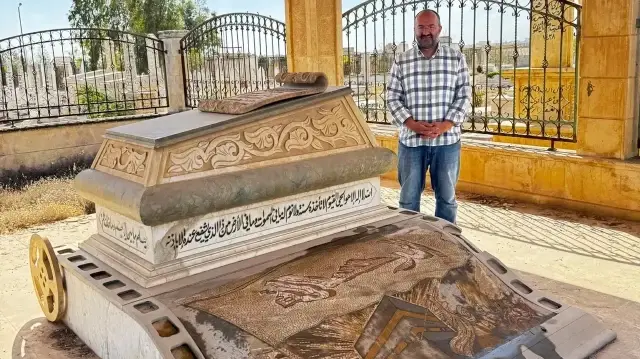
Last week, from Wednesday to Sunday, I was in Syria. I had three dear friends with me. We moved step by step along a planned route, from the far north to the far south. When the trip ended and I thought about the places we’d visited, I said to myself: “We’ve visited the heroes of Islamic history.” And it’s true — almost all the figures whose graves we stood before and whose stories we spoke about were people we’d heard of since primary school. The fact that all of them are buried on Syrian soil is a testament to the blessings of Bilad al-Sham.
After flying from Istanbul to Gaziantep, we continued by road and entered Syria through the Öncüpınar border gate. Our first stop was in Azez, at the grave of Muhammed Ahmed Fâris, Syria’s first astronaut. Fâris went to space in 1987 and later served as a colonel in the Syrian Air Force. When the uprising began in 2011, he joined the opposition and later moved to Türkiye. He passed away on April 19, 2024, from a heart attack and never lived to see the fall of the Ba’ath regime.
After Azez, we visited Abdulbâsit Sârût, known as the “Nightingale of the Revolution,” whose powerful chants are still remembered today. Finding his grave in Dana, Idlib was easy. Everyone we asked — especially the children and youth — pointed the way without a second of hesitation. It was the same in Azez with the grave of Muhammed Fâris. Seeing how vividly Syria’s young generation remembers its heroes gave us both joy and hope.
Advertisement
As we moved south, the modest grave of Umar ibn Abd al-Aziz, the “Fifth Rightly Guided Caliph,” in Maarrat al-Numan left a deep impression on us. Even though he ruled the Umayyad Caliphate for only three years between 717 and 720, his legacy has lived in Muslim hearts for centuries — just like his great-grandfather Umar ibn al-Khattab.
We left Hama and Homs for the return route and continued down to Damascus — truly one of the great cities of the Islamic world. Look at the names resting within walking distance of each other, and you’ll grasp the depth of history here: Salah ad-Din, Baibars, Nur ad-Din Zengi, Bilal ibn Rabah, Hafsa bint Umar, Muawiya I, Mehmed VI, Ibn Kathir, Ibn Qayyim al-Jawziyya, Ibn Taymiyyah, Muhyiddin Ibn Arabi, Abd al-Qadir al-Jazairi, Khalid al-Baghdadi… and countless other influential figures. Damascus holds so much history that you could trace Islamic history from its very beginnings to today just by walking among these graves. Now that travel is becoming easier, I’d recommend “grave route” journeys to anyone interested.
We spent one of our days in Damascus heading further south. In Nawa, we visited Al-Nawawi; in Daraa, we stopped at Al-Omari Mosque, where the 2011 uprising began; and in the village of Jiza, we paid our respects at the grave of Hamza al-Khatib. He was just 13 years old when he was brutally killed by the Ba’ath regime — his story left us both heartbroken and resolute. The most moving part of the visit was meeting Hamza’s mother, Samira, along with his uncles and cousins at their home. We sat beneath Hamza’s photograph on the wall and had an unforgettable conversation. They welcomed us with such warmth and sincerity, as if they had known us for years. They shared in detail what happened after Hamza’s martyrdom. As we were leaving, they said, “Tell your children about Hamza. Don’t forget him and don’t let others forget.” How could we ever forget little Hamza?
On the way back north, we saluted the grave of Yusuf al-Azma from afar in Maysalun. He was the commander of the final battle against the French in 1920, a patriot who had remained loyal to the Ottoman Empire until its very end. Passing through Dair Atiyah on our way to Homs, we remembered Wahbah al-Zuhayli — a quiet, devoted scholar who worked under the Ba’ath regime’s iron fist, focusing on teaching and writing.
Advertisement
Our stop in Homs was solely to visit the resting place of Khalid ibn al-Walid. Inside a mosque built during the Ottoman era — bombed during the war and later repaired — Khalid lies opposite Ubayd Allah ibn Umar, the son of Umar ibn al-Khattab.
One of the most powerful and emotional moments of the journey was visiting the grave of Moustapha Akkad, the legendary director of The Message and Lion of the Desert. Few people from Türkiye come here, so visiting Akkad’s grave in Aleppo and sharing its location felt like a personal duty. I can’t help but wish he’d lived to make the film he so longed to — about the conquest of Istanbul.
Of course, my impressions of Syria aren’t limited to graves. I’ll share more about the country’s current state and what I saw on the ground in my Saturday column, God willing.
Comments you share on our site are a valuable resource for other users. Please be respectful of different opinions and other users. Avoid using rude, aggressive, derogatory, or discriminatory language.