


The legacy of Umar ibn Abd al-Aziz: A grave, a revival, and a moral lineage

01:50, 10/12/2025, Wednesday • Yeni Şafak English News Center

The legacy of Umar ibn Abd al-Aziz: A grave, a revival, and a moral lineage
You know the famous story: One night, during his regular inspections of the streets of Madinah al-Munawwarah, Caliph Umar overhears a conversation between a mother who sold milk and her daughter. The mother wants to dilute the milk with water, while the daughter firmly refuses. Eventually, the girl tries to stop her mother by saying, “The Caliph has forbidden this.” When the mother replies, “How would the Caliph know what we are doing in the middle of the night?”, the daughter reminds her that even if the Caliph does not see them, they are always under divine watch. The woman’s attempt at deception fails, and the girl’s piety prevails. Umar is deeply moved by this scene. Come morning, he immediately looks into the family, sends word to them, and asks for this God-fearing girl’s hand in marriage for his son, Asim. From this marriage, Umar’s granddaughter Layla would later marry Abd al-Aziz ibn Marwan, one of the governors of Egypt during the Umayyad period, and from that union, in the year 680, Umar ibn Abd al-Aziz would be born.One of the greatest figures in Islamic history, Umar ibn Abd al-Aziz received an excellent education in Madinah al-Munawwarah, where he spent his childhood, and studied under leading figures of the Companions and the Successors. He was later married, in 705, to Fatimah, the daughter of his uncle Abd al-Malik ibn Marwan. Appointed governor of the Hijaz the following year, Umar held the post for seven years, during which he led major restoration projects in Mecca and Madinah. In 711, after criticizing the notorious oppression of the famous governor of Iraq, Hajjaj, Umar ibn Abd al-Aziz was dismissed from office and lived in Damascus until his appointment to the caliphate in 717.
The caliphate of Umar ibn Abd al-Aziz, which lasted only three years, nevertheless contained the refinements that would earn him the title “the Fifth Rightly Guided Caliph”: from balancing taxation to simplicity in his personal life, from ending the mistreatment of the Ahl al-Bayt to establishing internal peace across far-flung lands, his era is filled with initiatives that Muslims still deeply long for today.
The Fifth Rightly Guided Caliph, Umar ibn Abd al-Aziz, passed away—most likely due to poisoning—on a February day in 720 in the village of Dayr Siman near Marrat al-Nu‘man, close to Idlib, where he is buried. Out of respect for his regard for the Ahl al-Bayt, his grave was not attacked during the violent upheavals that followed the fall of the Umayyads. Sadly, however, during the recent war in Syria, Shiite militias set fire to his grave and shrine twice. In one of these attacks, the shrine was nearly completely destroyed by fire.
Whenever my path leads me to Syria, I make a point—no matter the inconvenience or disruption to my schedule—of stopping by the grave of Umar ibn Abd al-Aziz. During our most recent visit in October, when we stopped by once again, we noticed the construction of a mosque right next to the shrine. From the sign nearby, it was clear that the project was being carried out by the Ankara-based Kalem Foundation within the framework of an agreement signed with the Syrian Ministry of Awqaf. The work had officially begun on April 13, 2025, and was scheduled for completion on February 13, 2026. During our visit, we observed intense activity. Both the mosque-complex construction and the restoration of the shrine were progressing simultaneously.
This past Sunday (December 7), the official opening ceremony of the complex and the shrine took place. With the support of donors, the work had been accelerated, bringing the opening forward by two months so that it would coincide with the first anniversary of Syria’s liberation. The ceremony was attended by Osman Nuri Topbaş Hocaefendi, Abdullah Sert Hocaefendi, Kalem Foundation President Musa Şahin, the Mufti of Aleppo Ibrahim Shashu, and a large congregation. As I had programs scheduled at the same time in two different cities in Germany, I was unable to attend the ceremony, but my heart and mind were there.
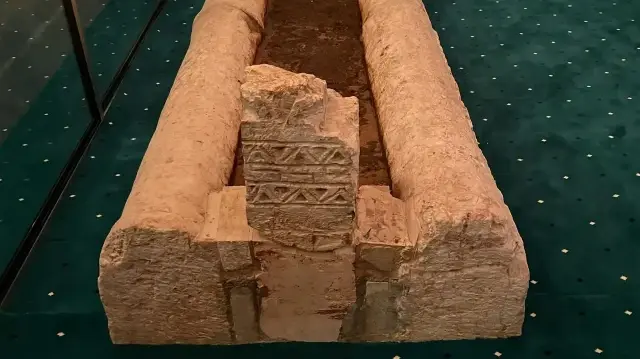
In keeping with his modest life, the grave of Umar ibn Abd al-Aziz is extremely simple: two small marker stones at the head and foot, an open grave covered with earth and surrounded by low marble edging no more than a handspan high. While observing the restoration work during our October visit, I had said, “God willing, this simplicity will not be disturbed. I wish the grave could be preserved exactly as it is and, in this state, convey Umar ibn Abd al-Aziz’s humility to visitors.” Praise be to God, when the work was completed, I saw that the grave had indeed been preserved in its original form. I would like to express my particular thanks to the Kalem Foundation for this attentiveness.
The Umar ibn Abd al-Aziz Complex, inaugurated on the anniversary of the revolution, suits Syria perfectly. May the hands of all those who labored on it never know hardship.