


Keeping EU, US ‘white’ is about ‘preserving Western civilization’
Dhoruba al-Mujahid bin Wahad evaluates white supremacy and the demise of the West
Dhoruba al-Mujahid bin Wahad, an American writer and activist, who is a former prisoner, Black Panther Party leader, and co-founder of the Black Liberation Army, evaluated white supremacy and the demise of the West.
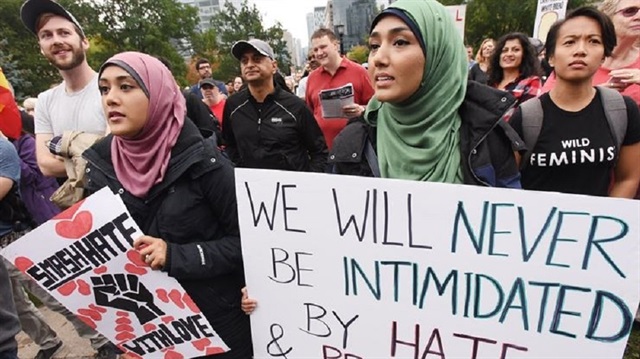
“If racism and white supremacy is in the socio-economic fabric of a nation, in its national DNA so to speak, it doesn’t take much to turn that society into an overtly racist xenophobic nation. Keeping Europe and America ‘white’ is what the European right is truly saying today when they babble about ‘preserving Western Civilization,’ ‘national identity’ and ‘cultural assimilation,’” Wahad said.
Q: There is an increase in Islamophobia in Europe and also in America. In correlation to this, hostility against migrants is also increasing. Muslims are being attacked, and migrants are left to die in camps. In spite of this, Europe claims that human rights is their strong suit. When did racism and Islamophobia start to increase? What are the causes of this increase?
DBW: Ever since the so called “age of discovery” (a European academic nicety for European mercantile imperialism and creation of European settler colonies), the socio-religious construct or formulation of “White Supremacy” truly became a justification for the colonial greed of European states, many of them still feudal monarchies, as they murdered native peoples of color, appropriated their lands and institutionalized African chattel slavery for the primitive accumulation of capital that would launch Europe into the “industrial age.” The dehumanization of peoples of color from this era still exists in Europe today.

Q: Extreme right-wing parties are trying to bolster their vote potential through xenophobia and Islamophobia, and are succeeding. Do you think politics pushes society in this direction or does the society's preferences shape politics?
DBW: Everything is political. Human beings are social, sentient beings, and actually rely more on collective cooperation to survive more than individual competition. The word “politics” derived from The Greek word “polis” meaning “city” or “community,” and the related word polītēs, meaning “citizen,” give us the roots polis and polit. Politics therefore have everything to do with communities or the citizens that live in them and how they regulate their affairs and governments. If racism and white supremacy is in the socio-economic fabric of a nation, in its national DNA so to speak, it doesn’t take much to turn that society into an overtly racist xenophobic Nation. So you can say that a societies “preferences” push them in a particular direction. We must keep in mind that the present upsurge of expressed xenophobia in Europe is directly connected to racial fear. Europeans are afraid they will become marginalized by people of color with higher birthrates. Europeans fear the inevitable repercussions of six centuries of genocide, rape, and pillage of a world in which they are melanin deficient and in which they have institutionalized that deficiency as White supremacy. Keeping Europe and America white is what the European right is truly saying today when they babble about “preserving Western civilization”, “national identity” and “cultural assimilation.”

Q: Does the shifting of economic power balances in the global sense impact these developments?
Absolutely! By this question I am assuming the “deterioration of economic power balances” refers to the rise of China as a global rival to Western Finance Capitalism that currently dominates the world economy. In this context, Chinese economic expansion undercuts Western, especially American, economic hegemony and their unimpeded access to resources. The U.S. has favored the use of embargoes, economic sabotage, and trade sanctions on nations like Cuba, Iran, Venezuela, for the specific purpose of maintaining its economic, and geo-political dominance in those regions of the world vital to its continued domination of the global economy. American and French “regime change” in Libya is a prime example. When the Khaddafi regime began to move toward a “Pan-African” economic paradigm, undermining the U.S. dollar as the global trading currency for oil, calling for an African common market, he was overthrown and murdered, all under the bogus pretext of “preventing a humanitarian disaster.” Afterwards, the U.S. ratcheted up its military footprint on the African continent expanding AFROCOM, and creating bases for so called “anti-terrorist” operations. The U.S. and its NATO allies are now waging clandestine wars against “Islamist terrorists” across the Sahel, in the Congo, Somalia, Mali, Cameroun, Nigeria, CAR, while providing dozens of despotic regimes across Africa with military assistance. The migrant crisis currently facing Europe and the U.S. is a direct consequence of their policies and exploitation in sub- Saharan Africa.

Q: How do you evaluate the politics and the attitudes of Muslim countries in regard to the Palestinian cause and other persecuted Muslims?
DBW: After WWI and the dissolution of the Ottoman Empire, the West, especially England, France, Belgium, the victors in the conflict, fashioned into being many of the Arab nations that exist today, recognizing powerful Arab clans, and tribes as “protectorates” of European oil access. Between the two world wars, these neo-colonial entities began consolidating their power, Trans-Jordan became Jordan, and Syria, Iraq, UAE, Kuwait, Oman, Yemen all began their modern existence with this European neo-colonial balkanization process. Even modern Saudi Arabia, which had been a British colonial project to stimulate the Arab overthrow of Turkish Ottoman rule in the Hijaz, which begun in 1902, didn’t really come to fruition until 1934 when Ibn Saud (King Abdulazziz) wrested control Riyadh and established “Kingdom of Saudi Arabia. Given this history, Arab nationalism evolved whole cloth from European neo-colonial machinations in the region. The hatred of European Christians for Ashkenazi Jews that culminated in their slaughter would result in the Palestinians paying the price for Europe’s perfidy. Once the European settler state of Israel was established, and consolidated after the first “Arab-Israeli war,” every Arab nation in the region, many of whom owe their very existence to the British and Europeans found themselves in a dilemma. To oppose the European settler-state of Israel military supremacy in the Levant, and control of Palestine meant they also opposed their benefactors – oil-thirsty Europe- and the new power on the scene: the U.S.. The result was and still is, Arab lip service supporting the rights of the Palestinians while dancing to the tune of the white supremacist West, who saw Arabs as little more than “rag heads” and “camel jockeys”. The use of oil embargoes against Europe and America to counter their unflinching support for the Zionist state was quickly abandoned as viable strategy of support by Arab oil producing nations, because their European and American clients were also their protectors against both internal and external threats to the regional Arab power elites. The rights of the Palestinians, their independence, for the region’s Arab governments is only moral talking point – nothing more. For the region’s Arab potentates, kings, and emirs, non-Arab, oil-producing Iran is their real enemy because it is the enemy of their European benefactors. Without Europe and America’s backing, few of the current mid-east Arab Nations would collapse, be overthrown, or radically transformed.
Q: You were born in an era when racism was at its peak in America. Fighting against racism and fascism landed you in prison, but it allowed you to learn about Islam. Could you describe this period?
DBW: Despite the race and class analysis that drove BPP activities, the organization and the black liberation movements were ill prepared to cope with the historic moment. The BPP’s strategic vision by late 1968 became increasingly focused on the burgeoning corporate police state and what its leading members saw as the precipitous consolidation of corporate, military, and police power that would criminalize and crush civil unrest, and politically redirect popular anti-war sentiment into more “institutional” avenues reforms. The slogan and war cry of the BPP, “Power to the People, Black Power to Black People” had distilled in a few words, accompanied by a clinched fist, the sentiments of millions of people who felt controlled and exploited by the white supremacist state, culture, and political system. The BPP and all progressive movements of the period were living on the cusp of the historic reformation of two systems of economic and political control: Corporate/Capitalist Democracy and Authoritarian State Socialism. Both systems, fundamentally hierarchal and elitist, would ultimately coalesce into variations of the National-Security State Model that typify both so called “democratic” and “authoritarian” states today. But in 1968 community-based programs such as the free Breakfast for Children Program, health care clinics served the community but did not translate into sovereign thinking and collective political actions able to seize the historical moment.
Q; Can we say that the years you spent in prison shaped your resistance spirit?
DBW: Yes, Prison is a crippling experience. But it also can be an empowering test of your fortitude and character. Caging beasts or humans are abominations in eyes of Allah, we are born free but in submission to our Creator with our very first breath. Resistance in prison touches our deepest insecurities and fears, so when one emerges, he or she realizes deep down inside that without struggle against that which imprisons their humanity you have no real life. Therefore, while we must prepare ourselves collectively to wage many struggles at once, we must do so with a common sense of humanity and purpose. We must rekindle this flame and sense of purpose, but on a much higher level… We understand the limitations and imperatives of history, of a racist culture. The question is what we intend to do with it.
Comments you share on our site are a valuable resource for other users. Please be respectful of different opinions and other users. Avoid using rude, aggressive, derogatory, or discriminatory language.