


Turkish-led team discovers exoplanet in habitable zone 90 light-years away
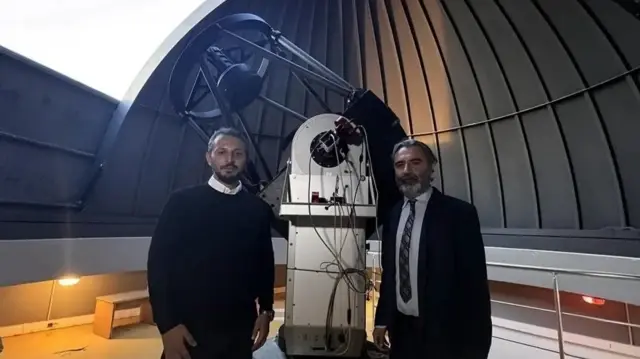
A Turkish-led international astronomy team has discovered four new exoplanets, including one within its star's habitable zone that could potentially support liquid water. The discovery marks a significant achievement for Türkiye's growing space research capabilities and international scientific collaboration.
A international team of astronomers led by Turkish researcher Selcuk Yalcinkaya has identified four previously unknown exoplanets, with one orbiting within its star's habitable zone where conditions might permit liquid water existence. The groundbreaking discovery, published in the prestigious Astronomy & Astrophysics journal, represents a major advancement in planetary science and demonstrates Türkiye's expanding role in global astronomical research.
Planetary Discovery Details
The research team documented two planets orbiting the star TOI-5799 and one each around TOI-1743 and TOI-6223, utilizing data from the AU Kreiken Observatory and Turkish National Observatory alongside nearly twenty international telescopes. The most significant finding, TOI-5799c, orbits within its star's habitable zone approximately 90 light-years from Earth and completes its orbital cycle every 14 days. With an estimated surface temperature of 63 degrees Celsius, this super-Earth-sized planet could potentially maintain liquid water depending on atmospheric conditions yet to be determined.
Research Methodology and Team Composition
Yalcinkaya, a PhD candidate at Ankara University, conducted the research as part of his doctoral thesis with support from TÜBİTAK's International Research Fellowship Program, including collaboration at Belgium's University of Liege. The international team employed both transit and radial velocity detection methods, cross-referencing data from NASA's TESS Space Telescope with ground-based observatory measurements to confirm the planetary candidates initially identified through space-based monitoring.
Advertisement
Future Research Directions
Professor Özgür Baştürk, the study's supervisor, emphasized that while TOI-5799c's position in the habitable zone doesn't guarantee life existence, it presents a prime candidate for atmospheric analysis using the James Webb Space Telescope. The research team aims to investigate potential biosignatures in the planet's atmosphere, which could provide insights into whether life-supporting conditions exist beyond our solar system. This discovery positions Türkiye at the forefront of exoplanet research and international scientific cooperation.
Comments you share on our site are a valuable resource for other users. Please be respectful of different opinions and other users. Avoid using rude, aggressive, derogatory, or discriminatory language.