


Conflicting Israeli Reports on Rafah Crossing Reopening for Gaza Aid
10:52, 15/10/2025, WednesdayU: Update: 10:59, 15/10/2025, Wednesday
AA

AA
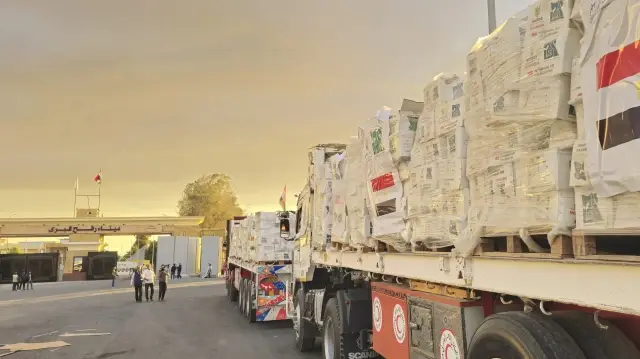
Trucks carrying humanitarian aid supplies pass through the Rafah Border Crossing following the ceasefire agreement in Rafah, Egypt on October 12, 2025.Contradictory reports have emerged from Israeli media regarding the reopening of Gaza's Rafah border crossing with Egypt. While one broadcaster announced its immediate reopening for humanitarian aid, security sources cited logistical delays, creating uncertainty about aid delivery timelines.
Conflicting information has emerged from Israeli media sources regarding the operational status of Gaza's crucial Rafah border crossing with Egypt. The discrepancies have created uncertainty about the timeline for resuming humanitarian aid deliveries to the Palestinian territory despite previous announcements of an imminent reopening.
Divergent Media Reports
Divergent Media Reports
Israel's public broadcaster KAN reported Wednesday that the country's political leadership had decided to reopen the Rafah crossing to facilitate the entry of humanitarian assistance into Gaza. The broadcaster indicated that approximately 600 aid trucks were scheduled to enter the Gaza Strip following the crossing's reopening. However, these reports were contradicted by the Israeli daily Yedioth Ahronoth, which cited an anonymous security official stating that logistical challenges would prevent the crossing from opening as anticipated.
Logistical Challenges and Timing
Logistical Challenges and Timing
According to the security source quoted by Yedioth Ahronoth, practical considerations made immediate reopening impossible. "It's not logistically possible. We need to go down to the area, inspect it, and send in a team — that takes time," the official explained. The source further indicated that the border would likely remain closed through Thursday, with no definite timeline established for its eventual reopening, highlighting the complex operational requirements involved in resuming border operations.
Humanitarian Context and Hostage Returns
Humanitarian Context and Hostage Returns
The Rafah crossing discussions follow Tuesday's transfer of four additional Israeli hostage remains by Hamas, building on Monday's exchange that saw 20 living hostages released and four bodies returned. These transfers occurred within the framework of the prisoner exchange that secured the freedom of nearly 2,000 Palestinian detainees. The ceasefire agreement, whose initial phase commenced Friday following President Trump's announcement, represents the most significant diplomatic breakthrough since the conflict escalation.
Ceasefire Implementation Framework
The current humanitarian arrangements form part of the comprehensive ceasefire agreement whose second phase envisions establishing new governance structures in Gaza without Hamas participation, deploying a multinational security force, and implementing disarmament measures. These developments aim to address the severe humanitarian consequences of military operations that have resulted in extensive casualties and destruction throughout Gaza since October 2023.