


Turkey and the new Mediterranean gas pipe projects
12:15, 08/06/2017, ThursdayU: Update: 12:20, 08/06/2017, Thursday
Derin Ekonomi Magazine

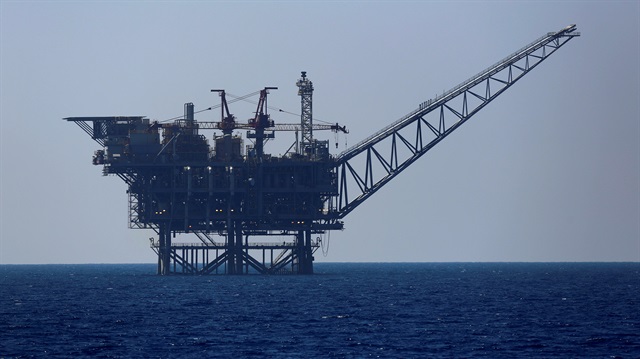
A gas platform is seen in the Mediterranean sea
In early April of 2017, the energy ministers of Cyprus, Greece, Israel, and Italy signed a Joint Declaration to reaffirm their support for the swift implementation of the EastMed/CrossMed natural gas pipeline project. European Commissioner Miguel Arias Canete attended the ministerial summit. (This "CrossMed" pipeline project should not be confused with the existing TransMed natural gas pipeline, which takes Algerian gas to the Italian mainland, via Tunisia and Sicily, and Slovenia via an extension.)
The EastMed natural gas pipeline project was originally conceived as a shorter pipeline from Cyprus to western Greece via Crete. The EU considers it as a Southern Gas Corridor project.
There is now an expanded project to extend it on both ends, eastward to Israeli offshore sources and westward under the Ionian Sea to Italy. This is this CrossMed pipeline, although sometimes "EastMed" is still confusingly used for it.
The current design of the project sees transit, in the first phase, of 10 billion cubic meters per year (bcm/y) of gas from the offshore deposits of Cyprus and Israel to Greece, then onward to Italy and/or South East Europe, and of which 1 bcm/y may be reserved for domestic Cypriot consumption. The second phase could see a doubling of that volume.
The CrossMed pipeline would re-animate the Poseidon pipeline project, from western Greece under the Ionian Sea to Italy, also known as the Interconnector Greece-Italy (IGI). Indeed, the IGI developer, a joint venture between Italian and Greek companies, is driving the CrossMed initiative and hoping for a final investment decision by 2020. There is also the possibility that gas from Israel and Cyprus would flow through Greece to the Interconnector Greece-Bulgaria (IGB), from where it could supply parts of Southeast Europe. The company behind the IGI is also behind the IGB, which is scheduled to enter into service in the second half of 2018, presumably carrying gas from TANAP exported by Turkey to Greece.
The EastMed pipeline is a Project of Common Interest of the European Union, so the EU co-financed the feasibility study. It would avoid the somnolent overland portion of the Interconnector Turkey-Greece-Italy (ITGI), across northern Greece, which Russia is trying to reanimate, probably as an eventual conduit for export sales of its own gas from TurkStream. (The undersea segment of ITGI is in fact the Poseidon pipeline itself.)
Russia pretends that the second phase of TurkStream gas might reach Southeast Europe through the proposed Tesla (Greece-FYROM-Serbia-Hungary) pipeline. The ITGI-Poseidon and Tesla routes are nothing but alternative branches of the old South Stream project. However, surveying and engineering for these routes was never done.
The EastMed/CrossMed pipeline is a clear competitor with TANAP gas for the southern European market (in particular Italy, which also connects onto Austria and the rest of Central Europe) as well as for the South East European market. From TANAP, 10 bcm/y are already planned to arrive in Italy via the Trans-Adriatic Pipeline (TAP), of which construction is already under way, and of which the volume could also later be doubled. The CrossMed pipeline gas would thus compete not only with TurkStream gas but also with TANAP gas for these same European markets.
Of course, the signature of the joint declaration on the CrossMed project does not mean that the pipeline will be constructed. Technical issues, financing issues, political issues, and legal issues may all intervene. Certainly, the gas would have to satisfy the EU's Third Energy Package requirements as well.
Turkey can benefit even if the CrossMed pipeline is not built.
Meetings concerning the possibility of Turkish gas imports from Israel have been going on already for some time. Although it was considered that a pipeline from Cyprus to Turkey might carry Israeli gas, this project has evolved to become separate from the EastMed/CrossMed project. Recent public statements suggest that a bilateral government-to-government statement on an agreement, setting the framework, is set for late summer. It is projected that Israeli gas could flow to Turkey in three years, whereas the CrossMed project would require at least six years for a final investment decision to be taken, before construction even starts.
The problem is that the pipeline from Israel to Turkey must pass through either the Lebanese and Syrian EEZs (which is at present a political impossibility), or through Cyprus's. But Turkey claims part of the Cyprus Exclusive Economic Zone (EEZ) as part of its own continental shelf. (Also, it sees the rest of the Cyprus's EEZ as jointly owned by both ethnic communities on the island rather than by Nicosia alone.)
Cyprus, under the UN Convention on the Law of the Sea, does not have the power to halt construction of such a pipeline; but it needs to be consulted. However, although no other state recognizes Turkey's claims on the EEZ, Turkey's international-political line on the question looks to have hardened over the last three years. Indeed, in the context of the intercommunal negotiations over Cyprus, the general international community (for example, both the U.S. and the
U.K.) expect that hydrocarbon revenues may be shared by both communities of Cyprus, in the context of a future overall general settlement.
It is an open question, whether any international company will begin construction of the Israel-Turkey pipeline in the absence of a settlement about the competing EEZ claims between Cyprus and Turkey. This is because it is unlikely that any insurer would insure the project.
Perhaps the Turkey-Israel joint declaration planned for this summer will find a way to address the issue. It would have to be a very creative approach in the absence of an overall settlement of the Cyprus conflict, because Nicosia would surely delay approval for as long as possible through requiring environmental impact statements and by other means.
It is definitely in Turkey's national interest to realize the pipeline project with Israel, if at all possible. That is because every country today seeks to diversify the sources of its energy imports. Turkey's already significant dependence on natural gas from Russia has only grown in recent years, and the TurkStream pipeline will do nothing to diminish that dependence.