


Greece's policy to assimilate Turkish minority results in school boycott
12:55, 18/12/2021, Saturday
AA

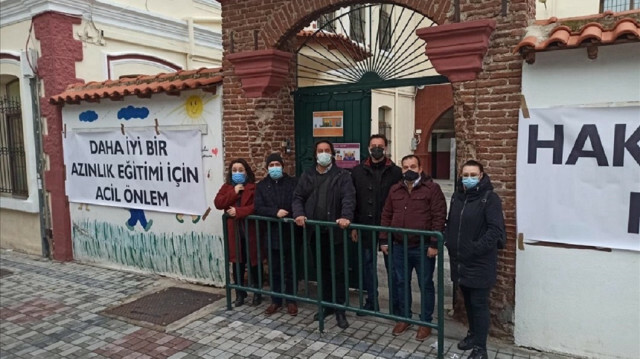
File photo
We want to use our rights derived by international treaties, law, says prominent minority figures
Greece's Turkish minority staged a widely-participated school boycott on Friday to protest the country's assimilation policies.
In many minority schools, participation in the boycott was total, and nearly total in others, said Hulya Emin, editor-in-chief of the Gundem newspaper published in the northeastern province of Komotini (Gumulcine).
Emin told Anadolu Agency that the boycott had not erupted for no reason.
For decades, Greece has imposed a strict and comprehensive policy of assimilation contradicting with its obligations in international treaties, including the Lausanne Treaty of 1923, and international and European law, she said.
"In September, Greek state officials issued a new regulation to hinder Muslim Turkish (students) from attending Friday prayers at schools, and that was the last straw that broke the camel's back," said Emin.
She said Greece wanted to undermine minority education in various ways, including by way of underfunding institutions, preventing Turkish-educated teachers from the minority from teaching at minority schools, and not permitting the minority to open kindergartens.
"By doing so, they intend to push the Turkish minority to send their children to Greek schools and hence assimilate them in the long term," she said.
She also drew attention to the government's attitude towards minorities, arguing that it has grown more negative in parallel with ongoing tensions between Turkey and Greece.
Even objective Greek media outlets and academics are afraid of speaking their minds on the actual state of affairs regarding the matter because of pressure from the state, said Emin.
"However, I would like to reiterate that we are citizens of Greece, with a Muslim Turkish identity. We just want to use our rights which were given us by our Greek citizenship, as well as international treaties and law," she said.
The immediate demand by the boycotters is for the Greek state to initiate dialogue with the committee that oversees minority schools, or the Encumen Heyeti, and other elected minority authorities and representatives, instead of appointed religious officials representing the Western Thrace Turkish Minority, she said.
Ahmet Kara, a lawyer and elected head of the minority school committee, agreed that Greece's pressure on the Turkish minority's schools is part of a larger assimilation policy.
"What we basically want is for the Greek state to respect our special rights on education which were established by international and bilateral treaties between Turkey and Greece. Nothing more, nothing less," he told Anadolu Agency.
Kara said minority representatives have spoken to EU officials on their situation.
"They, however, are not so enthusiastic about finding a solution to our problem or condemning Greek policies which are basically in violation of international and European law," he said.
- Greece's Muslim Turkish minority
Greece's Western Thrace region in the northeast near the Turkish border is home to a substantial, long-established Muslim Turkish minority numbering around 150,000.
The rights of the Turks of Western Thrace were guaranteed under the Treaty of Lausanne, a pact forged in the aftermath of World War I, but since then, the situation has steadily deteriorated.
After a Greek junta came to power in 1967, the Turks of Western Thrace started to face harsher persecution and rights abuses by the Greek state, often in blatant violation of European court rulings.
The Turkish minority faces problems concerning collective and civil rights and education, from banning d “Turkish” in the names of organizations to trying to block the community from electing imams.
In a violation of longstanding treaties, Greece decided to close 12 more schools serving the Muslim Turkish minority in August, claiming there are too few students.
Under an Education Ministry decree, eight schools in Rhodope (Rodop) and four in Xanthi (Iskece) in Western Thrace will be temporarily suspended, a move Turkey claims is planned and often proves permanent.
A total of 124 minority schools in the country have been systematically closed since 2011. The number of schools operating in the Rhodope, Xanthi and Evros provinces has dropped to 105, with officials citing a supposed lack of students as the reason.