


China’s Petro-yuan casts a large shadow over the petrodollar
10:58, 22/12/2017, FridayU: Update: 11:03, 22/12/2017, Friday
Derin Ekonomi Magazine

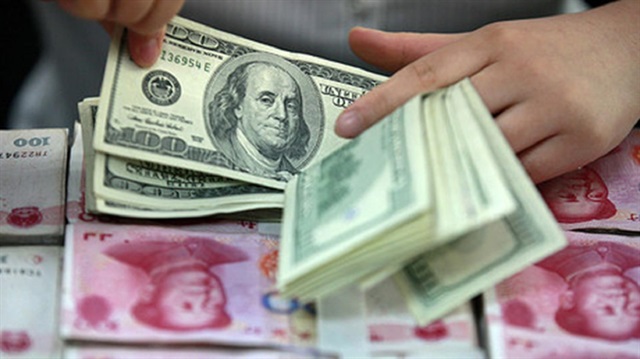
File Photo
Oil is like a coin: one side is economics and the other is geopolitics, and the two are inseparable.
The petrodollar came into existence in 1973 in the wake of the collapse of the international gold standard which was created in the aftermath of World War II under the Bretton Woods agreements. These agreements also established the U.S. dollar as the reserve currency of the world.
The Nixon Administration understood that the collapse of the gold standard system would cause a decline in global demand for the U.S. dollar. Maintaining that artificial demand for the dollar was vital for the United States’ economy.
So the United States under Nixon struck a deal in 1973 with Saudi Arabia. Under the terms of the deal, the Saudis would agree to price all of their oil exports in U.S. dollars exclusively and be open to investing their surplus oil proceeds in U.S. debt securities. In return, the United States offered weapons and protection of Saudi oilfields from neighbouring countries including Israel.
In 1975, all of the OPEC nations agreed to follow suit. Maintaining the petrodollar is America’s primary goal. Everything else is secondary.
The petrodollar system provides at least three immediate benefits to the United States. It increases global demand for U.S. dollars. It also increases global demand for U.S. debt securities, and it gives the United States the ability to buy oil with a currency it can print at will. In geopolitical terms, the petrodollar lends vast economic and political power to the United States.
China hopes to replicate this dynamic. A rising China is eyeing the benefits of having its own currency play a larger role and supplant the petrodollar in global trade. The initial focus of that trade is oil trade.
There are indications that the Chinese are now accelerating their long-term plan to dethrone the petrodollar. Right now, China is the number one exporter on the globe, the largest crude oil importer in the world and also the world’s largest economy with a GDP of $19.42 trillion in 2015 (compared to $17.95 trillion for the U.S.), based on purchasing power parity (PPP).
The Chinese scored a major success for their currency last year when the International Monetary Fund (IMF) included the yuan in its Special Drawing Right (SDR) basket along with the U.S. dollar, the euro, the yen and the British pound sterling.
In the aftermath of the Second World War, the U.S. accounted for 50 percent of the global economy. But by 1980 this had declined to 22 percent. Three decades of double-digit Chinese growth has reduced the U.S. share to 16 percent today.
Meanwhile, China’s share of the global economy has soared from 2 percent in 1980 to 18 percent in 2016. China is currently growing three times faster than the U.S.
Since the 1970s, the global oil trade has almost entirely been conducted in petrodollars. Beijing hopes to challenge the petrodollar by launching a crude oil futures contract on the Shanghai Energy Exchange (INE) denominated in Chinese yuan (petro-yuan) and convertible into gold at the end of this year, potentially creating the most important Asian oil benchmark and allowing oil exporters to bypass the U.S.-dollar denominated benchmarks by trading in yuan. This could have devastating effects on the U.S. economy. Moving oil trade out of the petrodollar into the petro-yuan will take initially between $600 billion and $800 billion worth of transactions out of the petrodollar. This will also mean a stronger demand for Chinese securities, goods and services.
But it won’t be easy to dethrone the petrodollar without the participation of some major oil producers like Russia and Saudi Arabia. Between them, Saudi Arabia and Russia account for 23 percent of global oil production and 25 percent of oil exports.
The key to the coming petro-yuan lies in Moscow. As the world’s biggest oil producer, Russia is vital to Beijing’s project. And, in turn, China is the only country with the heft to challenge the American financial hegemony.
A more significant development was Russia settling more oil contracts in Asian currencies, especially the Chinese yuan, the Hong Kong dollar and Singapore dollar. Moreover, Russia is also making moves which could have serious implications for the petrodollar. In addition to the Russian Miner Coin, the Kremlin announced that it will be creating a new state-endorsed cryptocurrency backed by gold. The goal of this coin is to allow free exchange between the crypto-rouble and the rouble and to reduce dependence on foreign currencies while stimulating the domestic online economy.
China is now trying to persuade Saudi Arabia to start accepting the yuan for its crude oil. If the Chinese succeed, other oil exporters could follow suit.
Saudi Arabia currently sells just over 1 million barrels of oil a day (mbd) to China, compared to 1.55 mbd by Russia. In fact, Russia has been taking market share away from Saudi Arabia in China. If Riyadh wants to avoid losing more ground, it may have to agree to petro-yuan sales. Recent reports that China’s large state-owned oil companies are considering an outright purchase of 5 percent of Saudi Aramco’s IPO, should be seen in this context. For Saudi Arabia, it will find itself caught between a rock and a hard place – lose the Chinese oil market or spark the ire of Washington.
And if China, having built massive gold reserves in recent years, allows any trade partners to exchange their petro-yuan revenues from oil directly into gold, it would vastly reduce the interest in holding foreign exchange reserves in U.S. dollars, increasing the interest in holding gold and yuan.
For China, there are a lot of upsides to this gambit. An oil futures market based on yuan will stimulate demand for the Chinese currency, which China believes will lend it strategic clout. That money is also more likely to be recycled back into the Chinese economy exactly as the United States has been benefiting from the petrodollar since 1973.
The launching of the crude oil benchmark on the Shanghai exchange could mark the beginning of the end for the petrodollar.
However, the biggest winner may well be in Moscow. Because any decline in the dollar’s status severely dilutes Washington’s ability to wage economic war against Russia via sanctions.
----------------------------------------------------------------------------------------------------------------
*Dr Mamdouh G. Salameh is an international oil economist. He is one of the world’s leading experts on oil. He is also a visiting professor of energy economics at the ESCP Europe Business School in London.