


A decade into Arab uprising: Tunisians keep on protesting
14:44, 27/01/2021, WednesdayU: Update: 14:49, 27/01/2021, Wednesday
AA

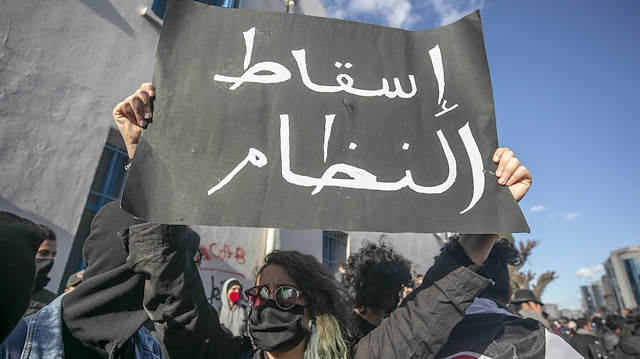
Protest in Tunis
Today, Tunisians have a democratic, free country, but their quest for a dignified existence and adequate standard of living is far from over
A decade after the Jasmine Revolution, which ousted longtime President Zine El Abidine Ben Ali from power, anger and frustration among young Tunisians continues to brew. Protests [1] have been held in various cities across the country over the last few days, defying restrictions in place following a surge in coronavirus cases.
While the daytime demonstrations are overwhelmingly peaceful, clashes occur with security forces take place during the night. More than 600 people were arrested [2], and the army was deployed to quell the tensions.
Protestors’ grievances are the same as they were a decade ago: unemployment, socio-economic inequality and rampant corruption.
Behind this latest saga of popular unrest is the country’s paralyzed politics. Since last year’s elections, Tunisia has had three different governments, with the most recent reshuffle [3] yet to be voted in the parliament. While politicians are occupied with jockeying for power, ordinary citizens pay the price of the impasse.
- Economy in tatters
Tunisia’s precarious economy has only worsened with the coronavirus crisis. To put it in perspective, as of 2020, according to the National Institute of Statistics, more than 35% [4] of the youth are unemployed, while one-fifth of the population lives below the poverty line.
The dire financial denominators [5] do not offer any signs of relief at the end of the tunnel. The economy contracted 8% last year, and the GDP fell by more than 20%, reaching an unprecedented low. Government spending to alleviate the socioeconomic repercussions of the virus has widened the budget deficit [6] to around 11% of the GDP, making it the highest in decades.
In a recent announcement, Prime Minister Hichem Mechichi stated [7] that the pandemic’s present-day cost is around US$2.9 billion. Looking back at the onset of the crisis, Tunisia was already in need of US$3 billion to meet its expenditures. [8] While it seems that external support [9] is inevitable to navigate through these circumstances, these loan schemes will further push the country into another debt cycle.
- Untenable status quo
The legislative election held in 2019, produced a highly divided parliament [10] as none of the political parties or blocs managed to secure more than 20% of the vote. The results were a reflection of the overall disappointment with the existing class of politicians. A similar trend was evident during the presidential election [11] carrying law professor Kais Saied, a political outsider, to victory.
As expected, the deeply fragmented parliament, which includes parties from a wide array of ideologies and interests, makes it almost impossible to reach consensus on pressing issues and taking bold action; particularly on economic problems. There is widespread skepticism about whether the government’s financial plans will succeed in rescuing the ailing economy.
Continuous politicking wastes the country’s precious time. Numerous attempts were made throughout last year to form a government and receive a vote of confidence. The parties preferred to settle for a political deadlock rather than hold a snap election, which might have dealt a further blow to their declining popularity.
Despite their differences, political parties seem to be acting in tandem, as if to ensure that the discord continues. This polarization, in turn, guarantees a four-year mandate in which palliative solutions are offered; ones that fall short of addressing the people’s core demands, exacerbating the sense of frustration among the population. This situation poses a major threat to Tunisia’s fragile democracy, fueling the rise of counterrevolutionary politicians such as Abir Moussi. [12]
- No end to political wrangling
Besides polarization, the ongoing political wrangling between President Saied and other top figures within the government presents another serious challenge.
Even though the president has a largely symbolic mandate based on the new constitution [13] enacted in 2014 after the revolution, President Saied has been engaged in elite political gamesmanship in a bid to shape the trajectory of the country by relying on his popular legitimacy. [14]
A prominent example of the political crisis between him and the leader of the Ennahda party, Rached Ghannouchi, which led to the resignation of the previous Prime Minister Elyes Fakhfakh. [15] With the president having the duty to appoint a new premier, Saied’s choice was Hichem Mechichi [16], who was not among the candidates proposed by the parliament, thereby giving rise to the notion that Mechichi would create a “president’s government”. However, contrary to the predictions, Mechichi’s appointment backfired on Saied, as there were regular reports about the prime minister’s feuds with the president [17].
It seems that Tunisians do not feel uneasy about the president’s moves so far. According to the polls, Saied’s popularity remains strong. [18] On the other hand, the polls indicate a worrying erosion of confidence in the government. Eighty percent of people say that the government is doing little or nothing to address their grievances. [19]
In many cases, slogans are chanted during the protests calling on the president to dissolve the parliament. As legitimate as the concerns of the populace may be under any conditions, it is only by new elections that a democratically elected government should be changed.
- More of the same?
In Tunisia, scattered and regional protests have become a norm rather than an exception. It remains to be seen, however, whether this new wave of demonstrations will gain momentum or die down. One thing is certain though: if the protestors continue to express their legitimate grievances through vandalism, it will give the government an excuse to circumvent their demands, putting violence at the epicenter of discussions.
Would the protests have a big impact? In a country like Tunisia, arguing that the demonstrations would not lead to change will be wrong. Applying substantial pressure for the government to implement socio-economic reforms, however, would entail rallying broad segments of society together with a well-thought-out strategy, clearly defined goals and a realistic roadmap. Otherwise, these manifestations of frustration will end up simply adding to the current chaos and playing into the hands of politicians like Abir Moussi.
Today, Tunisians have a democratic, free country, but their quest for a dignified existence and adequate standard of living is far from over.
By Elif Zaim
- Elif Zaim is a Deputy Researcher at TRT World Research Centre. Her research focuses on political and social issues in the Middle East and North Africa.