


Media flak directed at Ilhan Omar no surprise at all
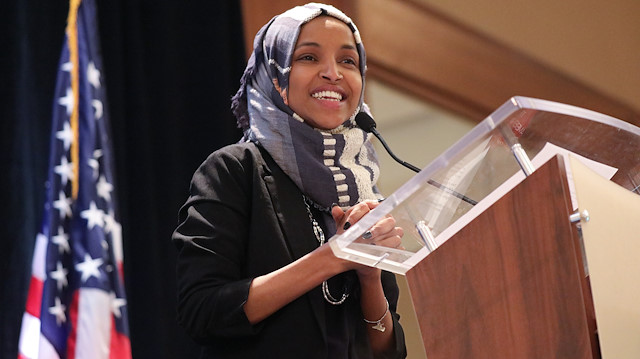
Apart from protecting Israel from criticism, the smear campaign directed against Omar is merely an attempt to stifle this new wave of youthful political activism, which paved the way for greater representation of minority groups and women in the U.S.
Recently, the American-Israel Public Affairs Committee (AIPAC) held its annual conference amidst political upheavals both in the United States and the Middle East. It is no secret that AIPAC has an enormously influential role in American politics and the organization’s events, and especially the annual AIPAC Policy Conference, are generally well attended by top political personalities in Washington D.C. and beyond.
During this year’s gathering, heavy criticism was directed to Democratic Congresswoman Ilhan Omar. For example, American Vice President Mike Pence said “recently, a freshman Democrat in Congress trafficked in repeated anti-Semitic tropes,” adding that “anyone who slanders those who support this historic alliance between the United States and Israel should never have a seat on the Foreign Affairs Committee of the United States House of Representatives.” [1]
It is interesting to note that Rep. Omar had not expressed anti-Semitic statements per se. She made comments [2] on Twitter about the nature of AIPAC’s influence in Washington. However, her remarks were distorted and taken out of context.
Advertisement
The smear campaign directed against Omar is merely an attempt to stifle this new wave of youthful political activism, which paved the way for greater representation of minority groups and women. This increasing influence of minorities in the political sphere is surely not to the liking of the Republican Party’s support base. The latter sees with suspicion the loss of urban and suburban centers to minority candidates. The new dynamics are set to alter the balance of power in the long-term since the current demographics that brought electoral victory to the Republican Party relies primarily on an aging populace of conservative whites.
This transformation is already affecting electoral behavior. For instance, in the aftermath of Nov. 7, 2018, the Democrats succeeded in wresting a 223-seat majority in the House of Representatives. In this context, Ilhan Omar (who is a Somali refugee) and Rashida Tlaib became the first Muslim women to be elected to Congress.
Interestingly, both Omar and Tlaib were singled out in the current AIPAC controversy. For example, Adam Milstein, one of AIPAC’s biggest donors, accused them of being representatives of the Muslim Brotherhood, [3] saying that their values “clash with American values.” [4]
Such outburst of accusations is indicative of the growing impatience among power centers in the U.S. The latter are used to having a firm grip on the political process and shaping the contours of political debate incontestably. In contrast, the emergence of strong counter-narratives by grassroots organizations disrupt the existing status quo and expose its fallacies.
Advertisement
The newcomers to the political realm in the country have a different view of the U.S. and its role in the world. They support democratic ideals and human rights values domestically and abroad while opposing the U.S. militaristic policies. In the long run, such a stance will shake the foundations upon which the U.S.-Israel alliance was established.
The U.S.-Israel strategic partnership is primarily rooted in the common interests between both parties, especially concerning their geopolitical interests in the Middle East. Moreover, there is also a deep-seated ideological cornerstone upon which this alliance is built. It consists of a mixture of the neo-conservative doctrine and the prejudices of Orientalist scholarship. This nexus rests, in the words of academic Rabab Abdulhadi, upon “hatred of Arabs and Muslims, identification with Israel, and racism towards decolonised “Third World” people of the global South, who are seen as inferior, primitive [and] backward.” (Abdulhadi, R. (2004). Imagining Justice and Peace in the Age of Empire. Peace Review, 16(1), 85-89)
Therefore, the media flak (to borrow the term of Herman and Chomsky) directed against Omar and others, does not come as a surprise. It is merely part of the institutional power’s response. Negative “public” responses are directed towards opposing narratives and positions to close down any serious discussion about the role and consequences of U.S. foreign policy in the world. Against this backdrop, harassing opinion leaders, academics, journalists, and activists can take many forms, such as social media hate campaigns, ads [5], trolling, letters, phone calls, speeches, and lawsuits.
Among the rhetorical devices used to intimidate Omar and like-minded politicians is to make the connection between Israel’s criticism and anti-Semitism. Such a misleading and pre-packaged conclusion helps frame the debate in a way that conceals both the political agendas at play and the lack of sound supporting reasons. The current controversy has nothing to do with anti-Semitism but is all about protecting Israel from criticism and conflating Zionism with Judaism.
All in all, it is not possible to silence those who question the rationale behind the U.S. policy towards Israel, especially in an era of information overload. By the same token, it is imperative for civil society organizations in the U.S. to have a better media presence, not only to push their narratives but also to prevent the spreading of falsehood within the public sphere. This will reinforce democratic politics and responsible journalism.
Advertisement
Lastly, since the campaign was fixated on making an example of Ilhan Omar, donating money to Omar’s campaign fund would be an adequate way of denying powerful organizations the power to censor alternative voices.
By Tarek Cherkaoui
The writer is Manager at TRT World Research Centre and the author of “The News Media at War: The Clash of Western and Arab Networks in the Middle East.” Cherkaoui is an expert in the field of strategic communications.
Comments you share on our site are a valuable resource for other users. Please be respectful of different opinions and other users. Avoid using rude, aggressive, derogatory, or discriminatory language.